Every week in Zimbabwe, someone starts a business out of necessity. A young woman sells produce from a roadside stand because formal employment never showed up. A young man builds a mobile repair shop with tools he saved up for over two years. A recent graduate launches a tutoring service because the school system can't absorb her, but the neighborhood can.
The entrepreneurial spirit in Zimbabwe is not a theory. It is survival, applied with creativity. The question Mazano Hub exists to answer is simple: what happens when that spirit gets structured support? |
||
|
|
||
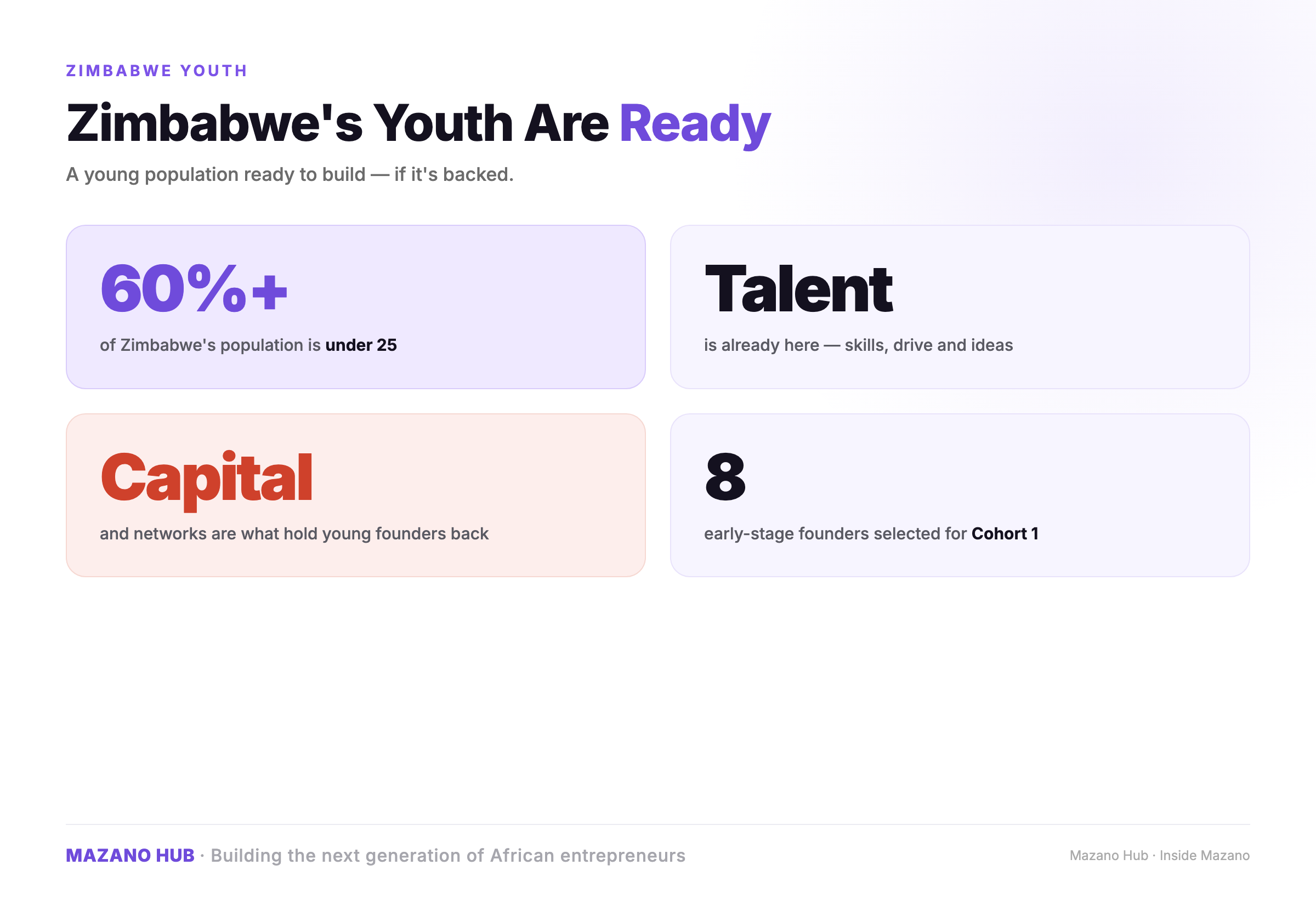
The Talent Is Already HereZimbabwe carries one of Africa's highest literacy rates — consistently above 88% — in a region where basic education access remains contested terrain. More than 60% of the population is under 25. That is not a statistic about youth unemployment. That is a statistic about untapped productive capacity on a scale most economies would envy. Young Zimbabwean founders are already building. In Harare's Mbare market, informal supply chains operate with a sophistication that rivals any logistics startup. In Bulawayo, small-scale manufacturers are solving local problems with local materials. Across the diaspora — in Johannesburg, London, Atlanta — Zimbabwean professionals send money home and wonder how to do more than wire transfers. The talent is not the constraint. The talent has never been the constraint. What's missing is the scaffolding that turns raw potential into durable enterprise — mentorship, accountability, community, and a framework for thinking through the hard decisions that every founder eventually faces. Zimbabwe's young entrepreneurs are already running. They just need someone to build the track with them. |
||
|
|
||
What Holds Them BackThe barriers facing young Zimbabwean founders are not abstractions. They are concrete and specific, and they compound on each other in ways that can stop even the most determined entrepreneur cold. Capital access. Banks in Zimbabwe require collateral that most young people don't have. Formal credit markets are inaccessible to unregistered businesses, and registering a business carries costs and complexity that disincentivize formalization. Microfinance options exist but carry high interest rates that pressure founders to prioritize short-term cash over long-term growth. Mentorship deficit. Most young founders in Zimbabwe have never sat across from someone who built a business they could study and learn from. Entrepreneurship is learned through proximity — you need to see it up close to understand what the hard decisions actually feel like. Without that proximity, founders repeat avoidable mistakes alone. Isolation. Building alone is exponentially harder than building inside a community. No one to sanity-check the pricing model. No one to call when a supplier cancels. No cohort of peers navigating the same terrain. Isolation compounds self-doubt, and self-doubt is the silent killer of businesses that should have survived. None of these barriers are permanent. All of them are solvable with the right structure. That is not optimism — that is what the data on structured incubation programs shows, consistently, across markets. |
||
|
|
||
The Case for Community-Led InvestmentDiaspora remittances to Zimbabwe have exceeded two billion dollars annually in recent years. That number represents something beyond economics — it represents trust, relationship, and a sustained belief in people back home. It is the largest, most consistent source of capital flowing into Zimbabwean households. And yet most of it flows into consumption, not investment. Not because diaspora professionals don't want to invest — many do — but because the infrastructure for doing so safely and effectively doesn't exist. There are no reliable intermediaries. There are no vetted entrepreneurs. There is no community of accountability holding both sides of the transaction together. Church networks and faith communities offer something that venture capital never will: relationship at scale. A church that has built trust with a congregation over decades has the infrastructure to introduce entrepreneurs to mentors, to vet character, and to hold participants accountable within a shared set of values. That is not soft capital. That is the most durable form of social capital that exists.
Community-led investment doesn't require equity stakes, term sheets, or credit histories. It requires trust, structure, and a common commitment to seeing people succeed. Those are things the church and the diaspora already have. Mazano is the bridge. |
||
|
|
||
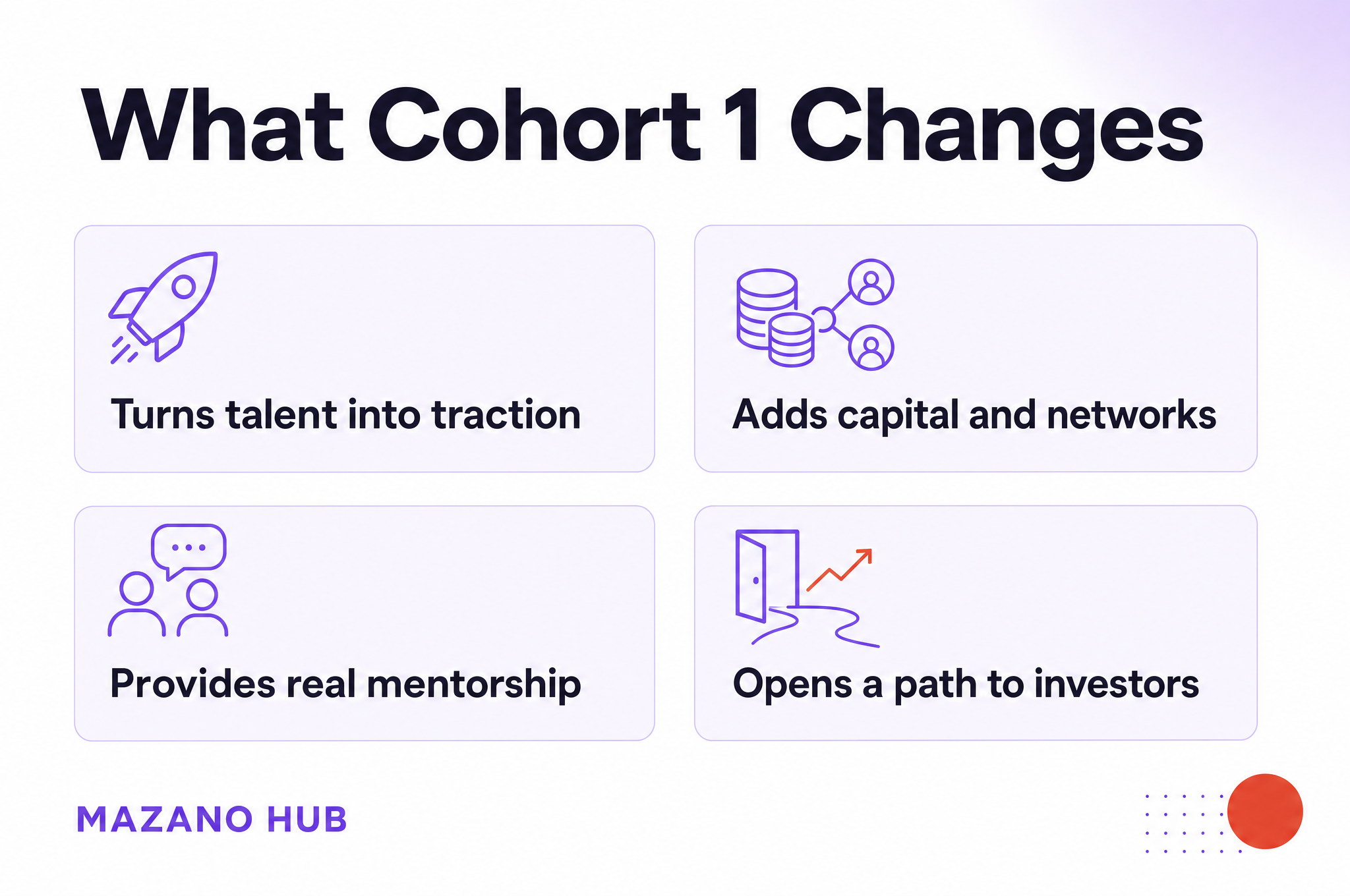
What Cohort 1 ChangesMazano Hub's Cohort 1 launches mid-2026 with eight carefully selected early-stage entrepreneurs. They will go through a six-month structured program built around three pillars: mentorship from experienced diaspora professionals, peer accountability within the cohort, and business fundamentals taught in the context of Zimbabwean market realities. Every component of the program is designed around what young Zimbabwean founders actually need — not a generic curriculum imported from Silicon Valley, but a program built for people navigating dual-currency environments, informal supply chains, and markets where trust is the real currency. The faith-driven framework is not incidental. It is the operating system. Stewardship, integrity, and service to community are not values we layer onto the curriculum — they are the reason Cohort 1 entrepreneurs were selected, and the standard against which their growth will be measured. Cohort 1 is the proof of concept. Eight founders. Six months. One community. If we get this right, we scale. And we believe we'll get it right — because the founders are ready, the mentors are committed, and the church partners who make it possible understand that investing in people is the most faithful thing they can do with their resources. |
||
|
Mazano Hub · May 2026 Zimbabwe's youth are not waiting to be discovered. They are building, right now, with whatever they have. Mazano exists because the people who believe in them — diaspora professionals, church partners, donors who understand that development is a people business — needed a vehicle. Cohort 1 is that vehicle. Support it, share it, and if you know someone who belongs in it, nominate them. |
||
|
Take Action Know a founder who belongs in Cohort 1?Applications are open. Nominate an entrepreneur or apply directly — Cohort 1 launches mid-2026 and seats are limited. Apply or Nominate at mazano.org |
||
|
Mazano Hub · Building Africa's Next Generation of Entrepreneurs
You are receiving this because you are a Mazano partner, donor, or subscriber. |