Before the business plan. Before the pitch deck. Before the grant application. There is often a conversation on a church steps, or an introduction made after Sunday service, or a phone call between two brothers in Christ who happen to be in the same industry. In Zimbabwe, this is not coincidence. This is infrastructure.
Zimbabwe's church networks — pentecostal assemblies, apostolic fellowships, mainline congregations, and the dense informal networks that connect them — have been quietly functioning as business ecosystems for decades. The entrepreneurs who understand this are using it deliberately. The ones who don't are leaving a significant advantage on the table. Mazano Hub was built to operate inside this reality. We are not asking founders to separate their faith from their work. We are asking them to recognize that their faith community may already be one of their greatest business assets — and to learn how to activate it well. |
||
|
|
||
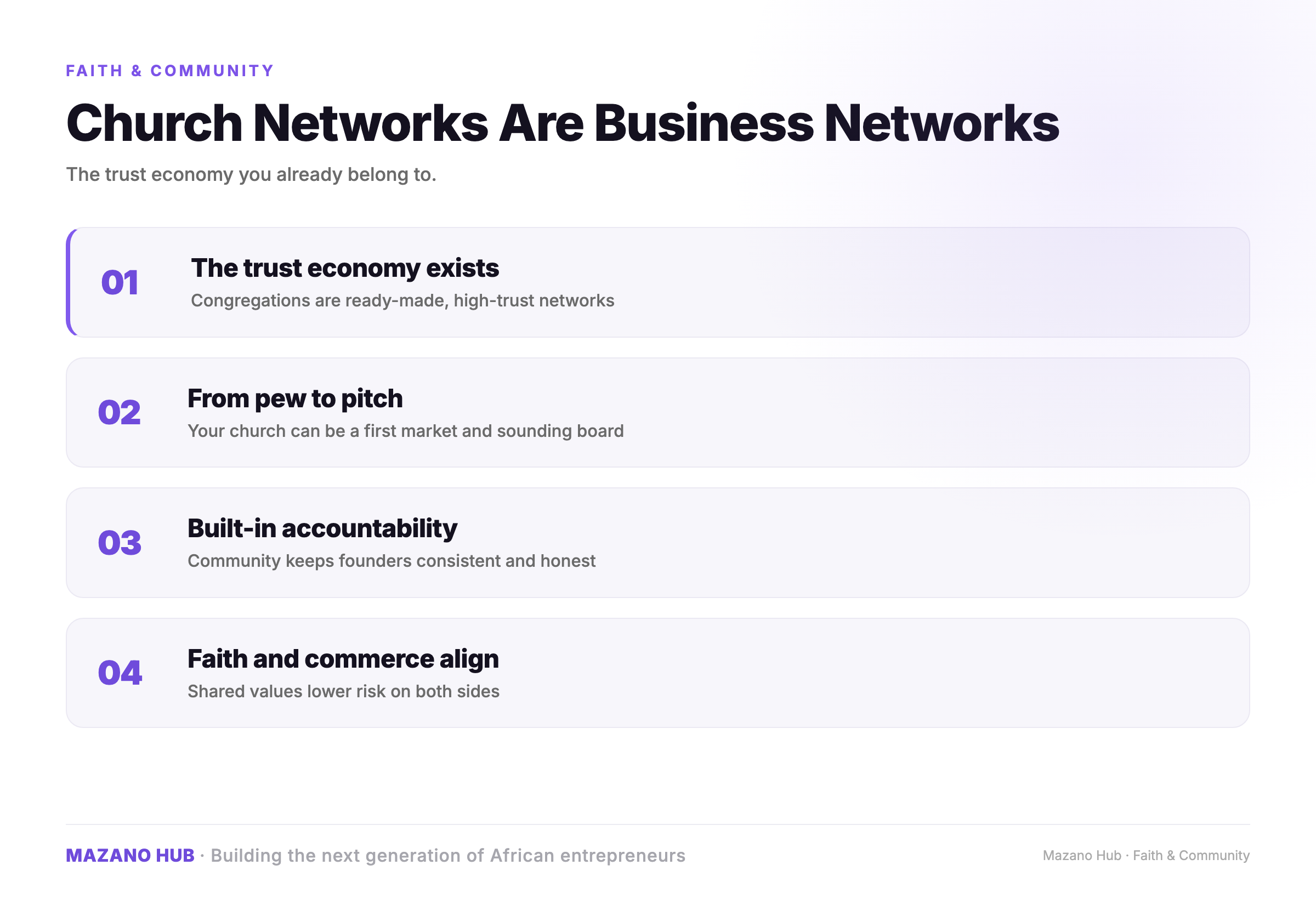
The Trust Economy Already ExistsEconomists talk about social capital as though it is abstract — a theorized resource in academic papers. In Zimbabwe's churches, it is a daily reality. Church members refer each other to trusted suppliers, vouch for each other in financial transactions, and pool resources in informal burial societies and savings clubs (chigadzirwa) that operate on nothing but relational trust. This trust economy predates any formal financial system in Zimbabwe, and in many ways, it has outlasted them. When the formal banking sector collapsed during the hyperinflation years, it was community-based networks — many of them church-rooted — that kept economic activity alive. Small goods traded. Services exchanged. Loans made on a handshake and repaid. For early-stage entrepreneurs, access to this trust network is not a nice-to-have. It is often the difference between finding your first customer and spending six months searching. A personal introduction from a respected church member converts at a rate no paid advertisement can match. The trust arrives pre-built. The entrepreneur's job is simply to deliver. What makes this network remarkable is its reach. A mid-sized Harare congregation might have members who are doctors, teachers, engineers, government officials, diaspora professionals, and subsistence farmers — all connected by a common faith and a shared weekly gathering. That is not a social circle. That is a market. |
||
|
|
||
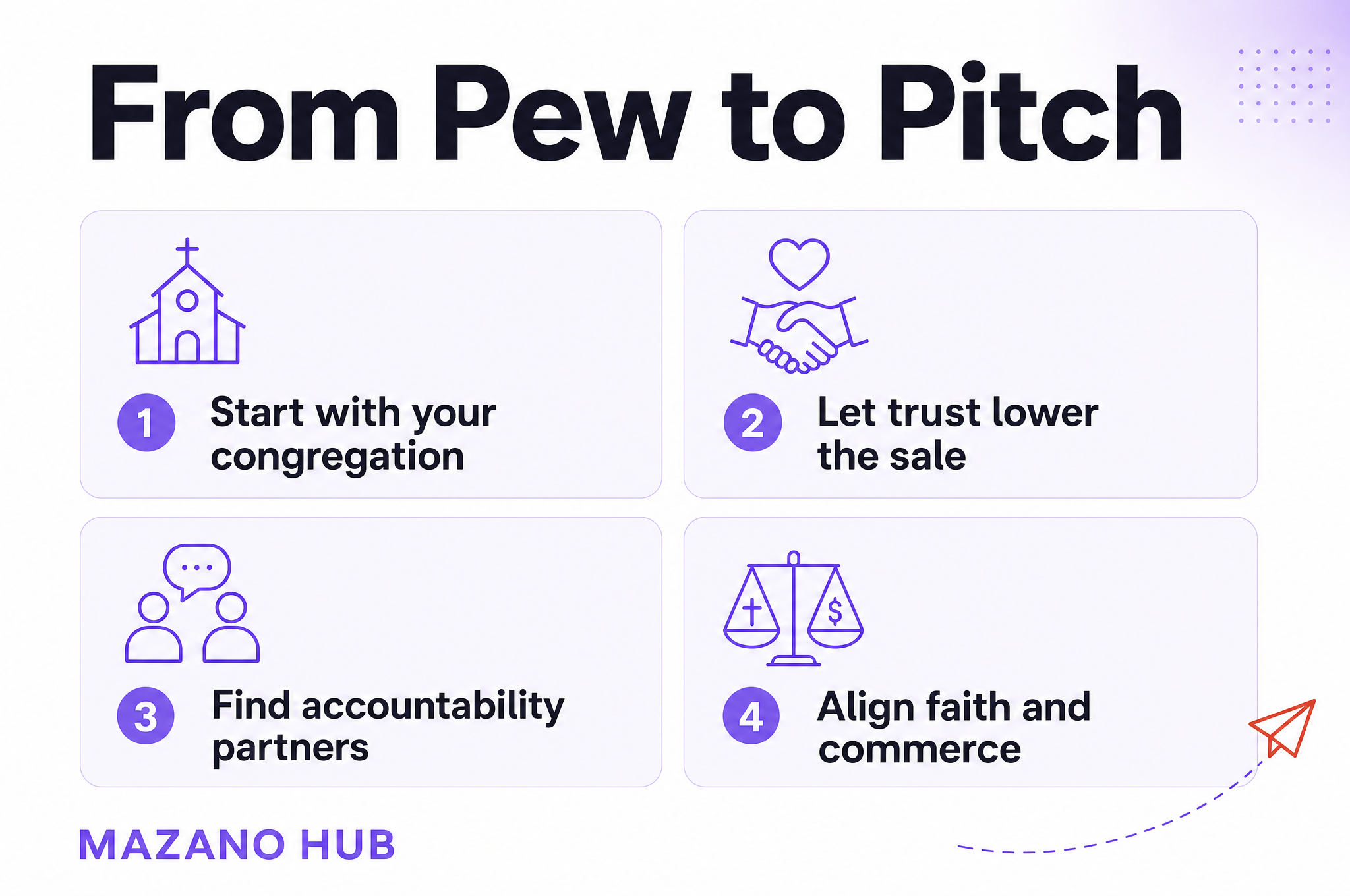
From Sunday Pew to Business PitchThe conversion of church relationships into business relationships is not theoretical. It is happening every week across Zimbabwe, in ways large and small. Consider the woman who runs a catering business out of Chitungwiza. She landed her first corporate contract because her church choir conductor happened to be an HR manager at a mining firm that needed a caterer for an all-staff event. She had the skills. He had the contact. Church was the connection point. That one contract led to three referrals, each of which led to more. Or consider the young man from Bulawayo who was trying to launch a mobile phone repair service. He couldn't afford shopfront rent and couldn't get foot traffic without a fixed location. His church gave him a table in the foyer every Sunday morning. The congregation became his first customer base. Within four months, he had enough repeat business to afford a small kiosk in Tredgold Market. Churches can also function as incubation infrastructure directly. Many congregations already host community halls, meeting spaces, and kitchen facilities that sit idle through the week. A few progressive church leaders are beginning to open these spaces to entrepreneur training, workshops, and pop-up markets — turning Sunday infrastructure into Monday-to-Saturday economic engines. None of these founders needed a formal program to begin. They needed a community that already trusted them — and the clarity to see the business opportunity embedded in that trust. |
||
|
|
||
The Accountability Gap in African EntrepreneurshipAsk any early-stage entrepreneur what slows them down and the honest answer is rarely money. It's consistency. It's the discipline to execute when motivation fades. It's knowing that someone is watching — not to judge, but to hold the standard. This is the accountability gap, and it is one of the most underaddressed problems in African entrepreneurship support. Incubators provide training. Angel investors provide capital. Mentors provide guidance. But week-to-week accountability — the steady, relational pressure to show up and follow through — is rarely structured into any program. Church communities fill this gap naturally. The weekly gathering rhythm creates a default check-in cadence. Faith accountability — the sense that one's work is part of a larger calling — creates intrinsic motivation that outlasts any external incentive. And the reputational stakes inside a tight community create a form of social accountability that is more powerful than any formal review process. Research from across sub-Saharan Africa consistently shows that entrepreneurs embedded in stable community networks have better long-term persistence rates than their isolated peers. They face the same obstacles. They have access to roughly the same capital. But the community-embedded founder keeps going when the isolated founder stops. This is not soft data. It is a survival advantage, and it is available to any Zimbabwean founder willing to engage their church community as a genuine business partner — not just a place of worship.
|
||
|
|
||
What Happens When Faith and Commerce AlignThere is a version of faith-and-business that is transactional and thin — a pastor who blesses your shop opening, a tithe offered in exchange for prosperity. That version is widespread and we are not describing it here. The version we are describing is deeper. It is the entrepreneur who sees their business as a vehicle for Kingdom impact — not as a metaphor, but as a daily operational commitment. Honest pricing. Fair treatment of workers. Products that genuinely serve. A portion of profit directed toward community need. Work done with excellence because it reflects something greater than personal gain. When this alignment takes hold, something notable happens. Customers sense it. Employees feel it. The business develops a reputation that no marketing budget can manufacture. In markets where trust is scarce — and in Zimbabwe, formal institutional trust has been eroded by decades of political and economic instability — a business built on genuine values is a competitive advantage. Diaspora Zimbabweans are watching this closely. Many want to invest back home but cannot find businesses they trust with their money. A faith-rooted, community-embedded entrepreneur with a verifiable track record is exactly the kind of operator that can attract diaspora capital. That is a real pipeline, and it begins with the kind of character formation that good church community produces over time. |
||
|
|
||
What This Means for Mazano Cohort 1Mazano Hub was not designed as a faith-adjacent incubator. It was designed as a faith-integrated one. Biblical principles of stewardship, servant leadership, and honest commerce are not decorative elements in our curriculum — they are structural. They shape how participants learn to treat their customers, build their teams, and manage their resources. As we prepare to launch Next Step Bootcamp Cohort 1 in Q2 2026, we are actively recruiting participants who are embedded in community — founders who already have church networks, neighborhood relationships, and family accountability structures that will amplify everything they learn in the program. We are not asking participants to build their network. We are asking them to bring the network they already have and learn to use it better. We are also extending an invitation to Zimbabwe's church leaders. If your congregation has members with entrepreneurial ambitions, Mazano can be the structure that takes those ambitions somewhere. We are looking for church partners who want to do more than pray over their members' businesses — partners who want to be part of building them. |
||
|
||
|
Mazano Hub · 716 Maple Street, Sunway City, Harare, Zimbabwe mazano.org · [email protected] You are receiving this because you subscribed to Mazano Hub updates. Unsubscribe |