Newsletter · March 28, 2026 · Capital & Networks
Africa's Entrepreneurs Are Ready. Is the Capital?
Venture capital is flowing into Africa — but it rarely reaches the founders who need it most, and Zimbabwe's builders are watching from the sidelines.
Where the Money Actually Goes
African startups raised over $5 billion in venture capital in 2022 — a figure that made global headlines and fueled narratives about the continent's entrepreneurial boom. But the data beneath those headlines tells a different story. Four countries — Nigeria, Kenya, South Africa, and Egypt — captured 90% of that funding. Within those markets, fintech and mobility startups commanded the lion's share. Series A and later-stage deals dominated, while seed and pre-seed rounds represented less than 15% of total capital deployed.
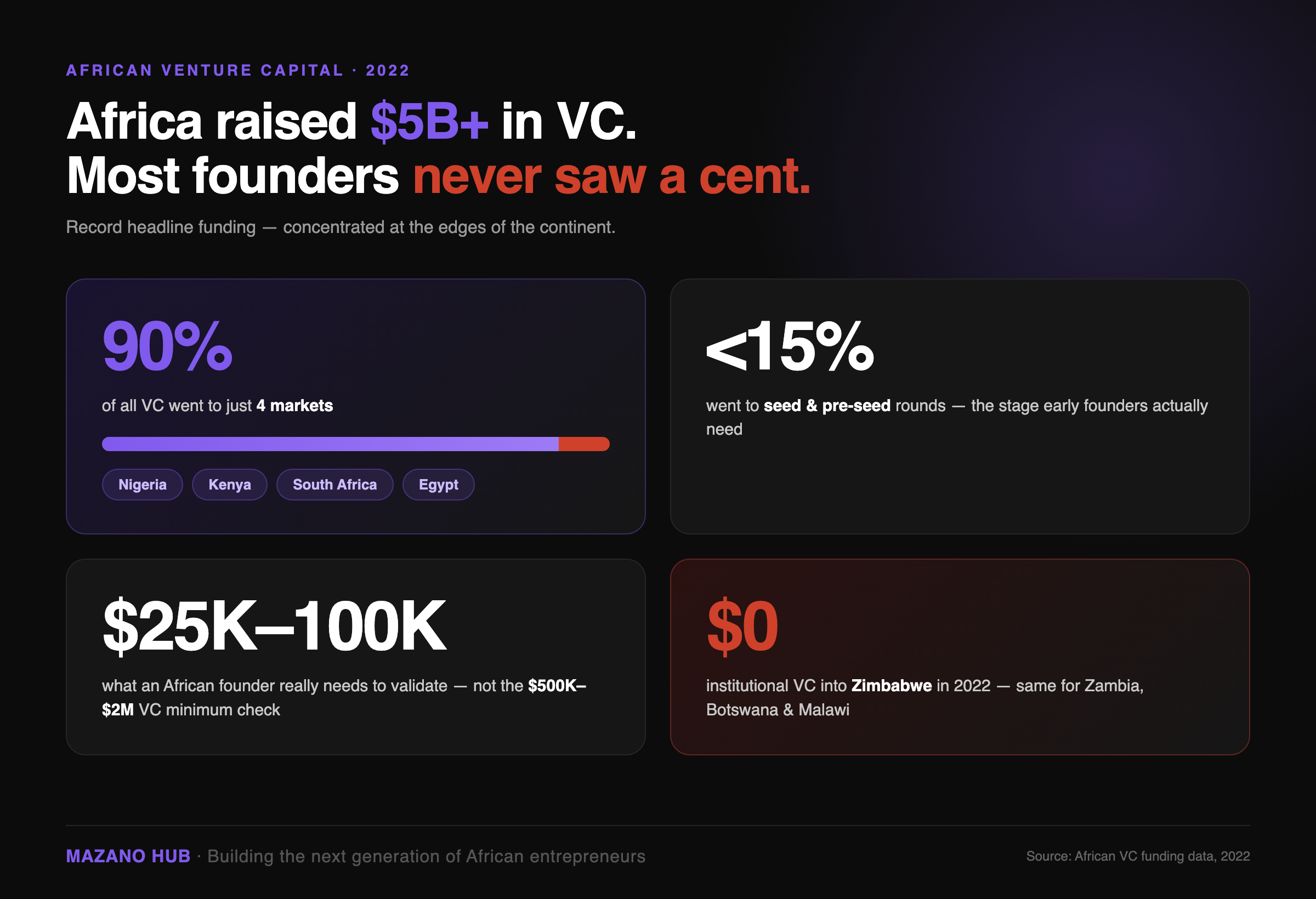
Africa's record VC year — and how little of it reached early-stage founders. |
Zimbabwe, despite producing globally competitive tech talent and hosting thriving informal entrepreneurship, recorded zero institutional venture investments in 2022. The same pattern holds across Zambia, Botswana, and Malawi. This is not a pipeline problem. Southern Africa has entrepreneurs building agricultural tech, e-commerce platforms, logistics solutions, and digital payment systems. They simply do not fit the ticket size, sector focus, or geographic comfort zone of international VCs flying into Lagos and Nairobi.
What the record-breaking funding rounds mask is this: African entrepreneurship is hyperlocal, and capital allocation remains concentrated at the edges of the continent. The founders building solutions for their immediate communities — the majority of African entrepreneurs — remain invisible to the funding ecosystem celebrating Africa's "tech revolution."
Why Traditional VC Models Fail Early-Stage African Founders
The venture capital model was designed in Silicon Valley for high-growth technology startups with clear paths to billion-dollar exits within seven to ten years. That model demands minimum check sizes of $500K–$2M, significant equity stakes of 20–30%, rapid user acquisition at scale, and liquid exit markets through IPOs or acquisitions. These assumptions break when applied to most African entrepreneurship.
African founders often need $25,000 to $100,000 to validate product-market fit, hire first employees, and establish operational infrastructure. They are building for markets where customer acquisition is slow, trust is earned face-to-face, and payment infrastructure is fragmented. Their businesses may take 10–15 years to reach scale — not because they lack ambition, but because market conditions demand patient growth. And exit opportunities barely exist outside South Africa and Nigeria.
The result is structural exclusion. VCs reject African founders not because their businesses lack potential but because their capital model cannot accommodate African market realities. Early-stage entrepreneurs in Zimbabwe face a particular catch-22: they need funding to become investor-ready, but they cannot access funding without already being investor-ready. Traditional venture capital does not solve this gap. It widens it.
Alternative Capital Pathways That Are Working
While traditional VC remains out of reach, other funding models are proving effective for early-stage African entrepreneurs. Development Finance Institutions (DFIs) like the African Development Bank deploy patient capital with longer return horizons and higher risk tolerance. Impact investors prioritize social outcomes alongside financial returns, backing businesses that would never clear a traditional VC threshold but create measurable community impact.
Diaspora-backed funds are emerging as critical players. African professionals in North America and Europe are pooling capital specifically to support entrepreneurs in their home countries, bringing both funding and networks. Foundation grants — from organizations like Tony Elumelu Foundation and Mastercard Foundation — provide non-dilutive capital that gives founders breathing room to experiment without sacrificing equity. Micro-grant programs, often under $50,000, meet entrepreneurs where they are and fund actual needs: product development, market testing, first hires.
Revenue-based financing is also gaining traction. Rather than taking equity, investors receive a percentage of monthly revenue until a predetermined return is achieved. This model aligns investor and founder incentives without imposing unrealistic growth timelines. These alternatives are not substitutes for venture capital. They are what venture capital never was: appropriate financing for entrepreneurs building real businesses in real African markets.
What Investor Readiness Really Means in This Context
"Investor readiness" is often wielded as a reason to dismiss African entrepreneurs. Founders are told they lack financial sophistication, business model clarity, or network access to compete for capital. This framing treats readiness as a founder deficiency rather than what it actually is: a preparation gap that structured support can close. Being investor-ready is not innate. It is learned.

Readiness is a preparation gap structured support can close — not a founder flaw. |
Investor readiness in the African context means understanding how to translate a business into the metrics investors care about: unit economics, customer acquisition cost, lifetime value, gross margin. It means building a pitch deck that communicates traction and opportunity in six slides. It means knowing which investors fund your stage, sector, and geography — and how to get introduced. It means preparing financial projections that balance ambition with realism. None of these skills are taught in Zimbabwean universities or accessible through online courses alone.
The entrepreneurs dismissed as "not ready" are frequently entrepreneurs who have never had access to the resources that make readiness possible. Close that access gap, and readiness follows. This is not theoretical. It is what incubation does when done right.
How Mazano Is Closing the Gap
Mazano Hub's Cohort 1 program, launching mid-2026 in Zimbabwe, exists to address this exact failure point. The program's third module — Capital and Networks — transforms invisible founders into investable ones. Participants learn fundraising literacy: how to value a company, structure a deal, negotiate terms, and identify the right capital source for their stage. They practice pitch delivery under real pressure. They build financial models that communicate both current reality and future potential.
A micro-grant pool gives select participants their first proof point — a disbursement record and demonstrated milestone achievement that strengthens their credibility with external funders after graduation. Mazano also curates introductions to diaspora investors, impact funds, and DFI partners who understand African market realities and are actively looking for deal flow in Southern Africa.
Demo Day at the end of the cohort is not a formality. It is a designed moment of visibility — Zimbabwean entrepreneurs pitching to an audience that includes institutional funders, corporate partners, and angel networks. Every element of the Mazano program, from mentorship matching to weekly accountability structures, moves entrepreneurs from overlooked to on-radar. This is how the gap closes. One cohort. One partnership. One founder at a time.
How You Can Participate
|