|
A decade ago, launching a business in Harare meant weeks of paperwork, a physical shop before any customer would take you seriously, and no reliable way to accept payments unless someone handed you cash. Getting your product in front of people outside your neighborhood was a project in itself.
That world is gone. Not everywhere, and not all at once — but the shift is real, and for African entrepreneurs paying attention, it is one of the most significant openings in a generation. Mobile money accounts now outnumber bank accounts across sub-Saharan Africa. Cloud tools that once required enterprise contracts are free or nearly free. Social platforms have given founders direct access to hundreds of thousands of potential customers at zero distribution cost. The infrastructure barriers that kept African startups perpetually at the margins have cracked open.
The question now is not whether technology enables African entrepreneurship. It does. The question is which founders have the skills, the grounding, and the support to act on what this moment makes possible. At Mazano, that question is exactly what we have built our program around.
|
The Infrastructure Shift That Changed Everything
Section 1
|
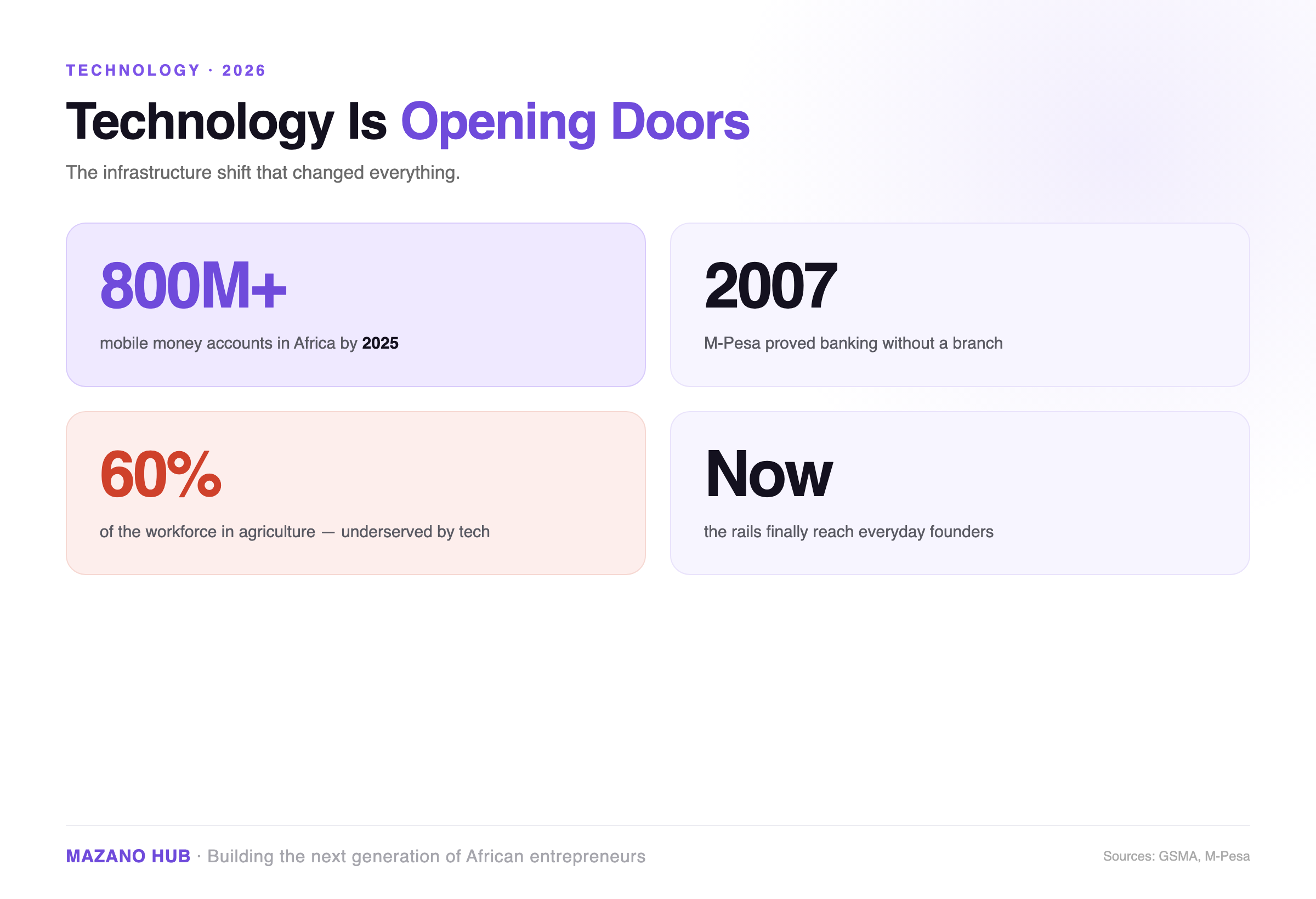
The clearest indicator of how much has changed is mobile money. M-Pesa launched in Kenya in 2007 and proved that financial services could be delivered through a basic phone without a bank branch in sight. What followed was one of the fastest infrastructure buildouts in financial history. By 2025, there were over 800 million mobile money accounts across Africa — more than the entire population of Europe.
For entrepreneurs, this is not a finance story. It is an operations story. A small business in Bulawayo can now accept payment from a customer in Nairobi without a merchant account, a bank transfer, or a middleman taking a large cut. A furniture maker in Harare can invoice a buyer in Johannesburg and get paid the same day. The friction that used to kill commerce between African entrepreneurs — slow, expensive, unreliable payment rails — is being dismantled.
Broadband access is accelerating in parallel. Starlink's expansion across the continent has brought reliable high-speed internet to rural and peri-urban areas that were previously cut off from the global digital economy. For entrepreneurs in Zimbabwe's secondary cities and farming communities, internet access is no longer the ceiling it once was.
Cloud computing has had the same leveling effect on software. The tools that a startup in Lagos uses to manage inventory, communicate with customers, and build a website are the same tools a startup in San Francisco uses. The cost difference is negligible. The knowledge gap is the only real gap remaining — and that gap is closable.
|
What African Tech Founders Are Building Right Now
Section 2
|
The most important thing about Africa's current wave of tech-enabled entrepreneurship is that it is not importing solutions from elsewhere and applying them here. It is building from the specific conditions of the continent — and in many cases, producing approaches that the rest of the world does not have yet.
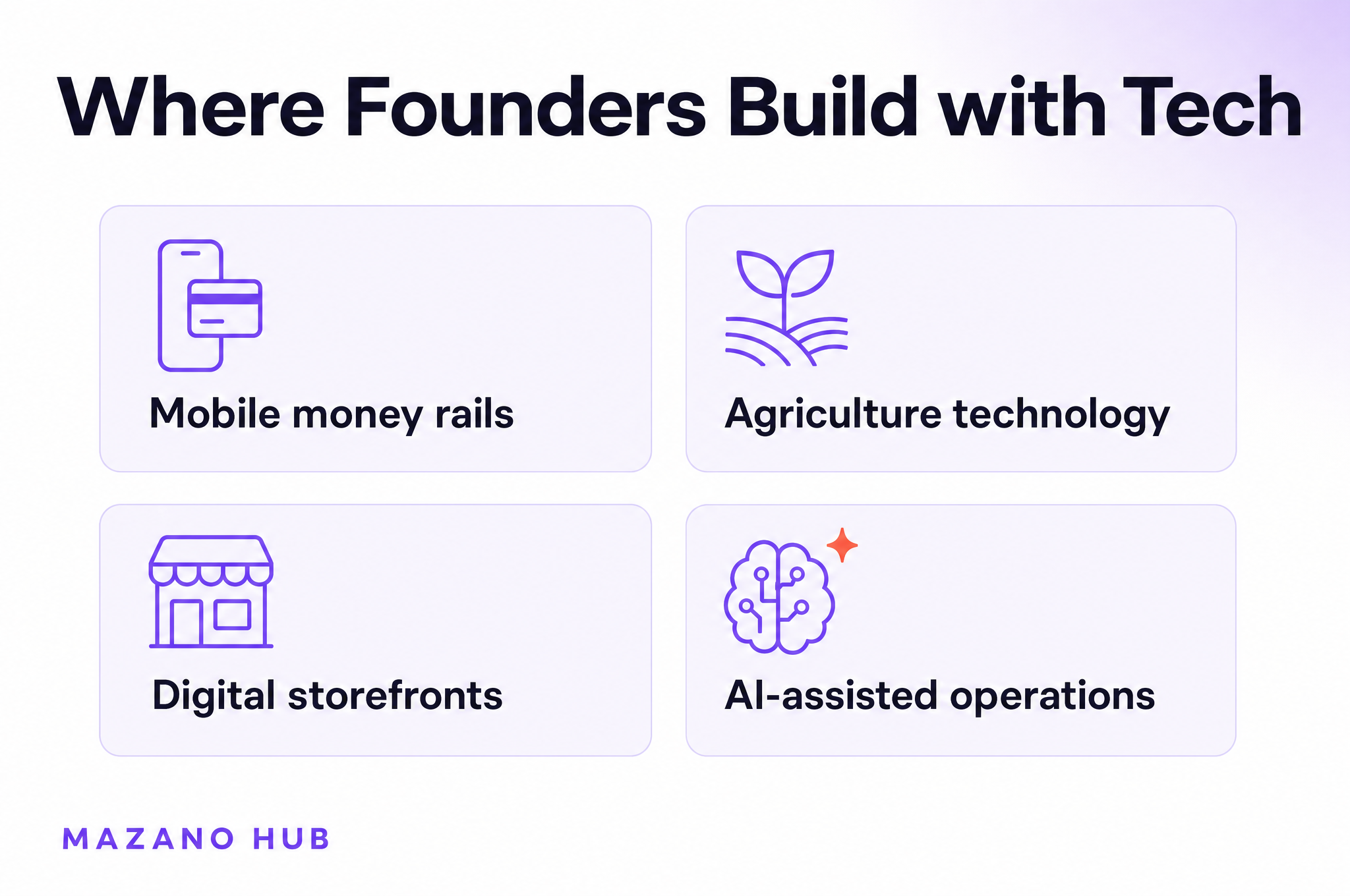
Fintech is the most visible example. Companies like Flutterwave, Chipper Cash, and Wave have built payment infrastructure purpose-designed for African markets — cross-border, mobile-first, and priced for mass adoption rather than elite access. They are not modified versions of PayPal. They are original solutions to original problems, and they are now processing billions of dollars annually.
Agritech is gaining ground. Over 60 percent of Africa's workforce is in agriculture, yet the sector has been chronically underserved by technology. New ventures are connecting smallholder farmers directly to urban buyers, using satellite imagery to advise on crop decisions, and providing access to inputs and credit through mobile platforms. The addressable market is enormous and largely untouched.
Healthtech and edtech are close behind. Remote diagnostic tools, telemedicine platforms, and digital learning applications are reaching populations that formal healthcare and education systems have never been able to serve efficiently. These are not niche products. They are addressing fundamental unmet needs at population scale — and the entrepreneurs building them are doing so with lean teams and modest capital, because the digital infrastructure now makes that possible.
|
The Skills Gap Standing Between Ideas and Impact
Section 3
|
Here is the honest challenge: the tools being available does not mean they are being used well. Across the continent, there is a persistent gap between the number of people who want to build technology-enabled businesses and the number who have the skills to build them effectively.
This is not primarily a technical skills gap, though that matters. It is a business fundamentals gap. Many aspiring entrepreneurs know how to build a product — or can learn quickly. Fewer know how to validate whether there is a customer for it before spending months in development. Fewer still know how to price for sustainability, manage cash flow in a high-inflation environment, or present their business to an investor in terms that make the opportunity legible. These are learnable skills. They are simply not being taught at scale.
Zimbabwe's educational system produces graduates who are among the most literate and numerate on the continent. The raw intellectual capital is not the constraint. What is missing is the bridge between that capability and the structured entrepreneurial practice — the frameworks, the feedback loops, the access to mentors who have built businesses and can help a founder avoid the mistakes that kill most early ventures in the first eighteen months.
When that bridge exists — when a talented founder has structured training, accountability, and the right connections — the results are disproportionate. Not every graduate becomes a scale business. But the ones who do create jobs, generate revenue, and demonstrate to the next cohort that it is possible. That demonstration effect is how ecosystems build momentum.
 Where Founders Build with Tech |
|
Faith-Driven Builders and the Technology Difference
Section 4
|
There is a question worth asking that most technology conversations skip: what does the entrepreneur building this believe about why it matters? The answer shapes everything — who they serve, how they treat their team, whether they cut corners when the pressure is on, and whether they stay when things get hard.
At Mazano, we believe that entrepreneurs grounded in faith bring something durable to their work. Not a guarantee of success — faith is not a business strategy. But a foundation that makes the work mean something beyond the metrics. A tech founder building a healthtech platform to serve rural communities because she believes she was put here to do exactly this will outwork, outlast, and outlove a competitor building the same product to hit a valuation milestone. That is not speculation. It is a pattern that shows up again and again in the most resilient businesses.
The biblical principle of stewardship applies directly to technology. The tools available to African entrepreneurs today are a form of provision — resources that have arrived at exactly the right moment in the continent's development. The question of stewardship is not whether to use them, but how to use them well: with integrity, with genuine service to the communities they are meant to reach, and with the long view that builds something sustainable rather than something that extracts and exits.
That is the kind of entrepreneurship Mazano is building toward. Not the fastest path to a liquidity event. The deepest path to lasting impact — businesses that create real jobs, solve real problems, and are still standing a decade from now.
|
|
Mazano Hub — Cohort 1
This is exactly the gap Mazano is built to close.
Our Next Step Bootcamp — launching with Cohort 1 in Q2 2026 — equips early-stage founders with the entrepreneurial frameworks, digital tools, and mentorship connections they need to build technology-enabled businesses that last. The program runs 10 weeks at our Harare facility on 716 Maple Street, Sunway City — with co-working space, high-speed connectivity, conference rooms, and a mentor network that spans Zimbabwe, the diaspora, and international investors.
We are specifically looking for founders building at the intersection of technology and real-world community impact — people who understand that the tools are ready, the market is opening, and the time to build is now.
|
|
|
Applications Now Open
Ready to build with us?
Cohort 1 of the Mazano Next Step Bootcamp launches Q2 2026. If you are an early-stage founder with a technology-driven idea and the drive to build it, we want to hear from you.
Visit mazano.org
|
|
|