Most early-stage founders in Africa learn by doing — and often by failing quietly. They piece together knowledge from YouTube videos, WhatsApp groups, and whatever mentors they happen to know personally. That works for some. For most, it leaves critical gaps.
Structured startup bootcamps exist to close those gaps on purpose. Not by accident, not over years, but over a focused ten-week window with a clear curriculum, committed mentors, and peer accountability built in. The difference in outcomes is measurable — and it matters more in high-stress, low-resource environments like Zimbabwe than almost anywhere else. Mazano Hub's Next Step Bootcamp is designed on exactly this model. Cohort 1 launches in Q2 2026. This week, we want to explain why structured programs produce results — and why we built ours the way we did. |
||
|
|
||
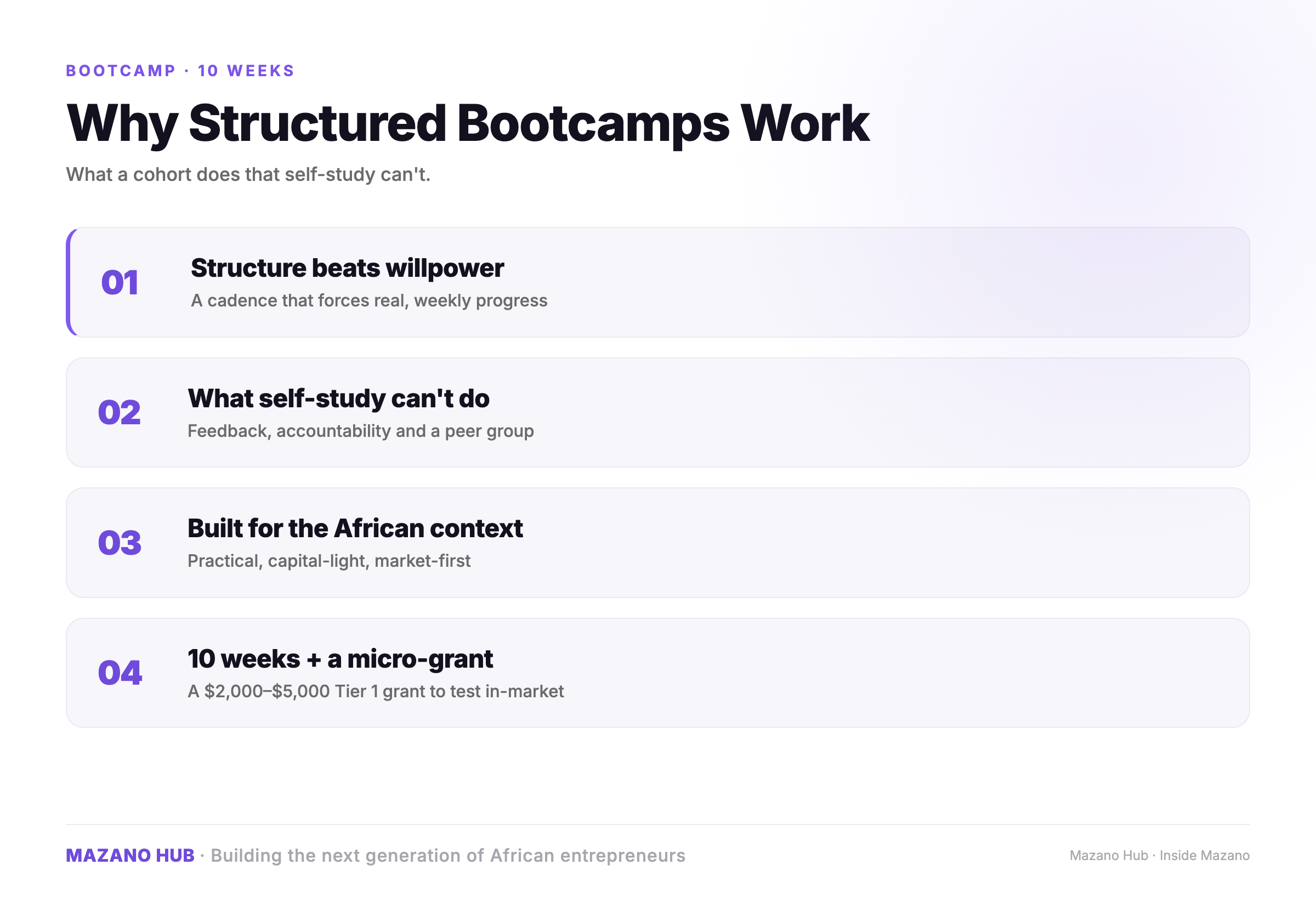
1. Why Structure Matters for Early-Stage FoundersThe word "bootcamp" gets used loosely. What it should mean is deliberate: a defined curriculum, a fixed timeline, and a structured sequence of learning that builds on itself. That sequence matters because startup challenges do not arrive in random order. Customer discovery comes before product development. Revenue modeling comes before investor pitches. Founders who skip steps get stuck at the same predictable points. Research from the Global Entrepreneurship Network consistently shows that founders who participate in structured programs are significantly more likely to still be operating twelve months after launch — not because the program gave them the answers, but because it forced them to ask the right questions at the right time. The curriculum compresses the trial-and-error period that kills most early ventures. There is also a psychological component. Informal learning is easy to deprioritize. When a supplier deal falls through or a family crisis hits, the YouTube course gets paused. A structured cohort creates external commitment — weekly check-ins, peer expectations, facilitator accountability. That external structure holds founders in the work when self-motivation alone would not. Structure is not rigidity. The best bootcamp programs build in flexibility for sector-specific needs and individual mentorship. But the framework itself — the sequence, the milestones, the cohort rhythm — is the intervention. It is what informal self-study cannot replicate. |
||
|
|
||
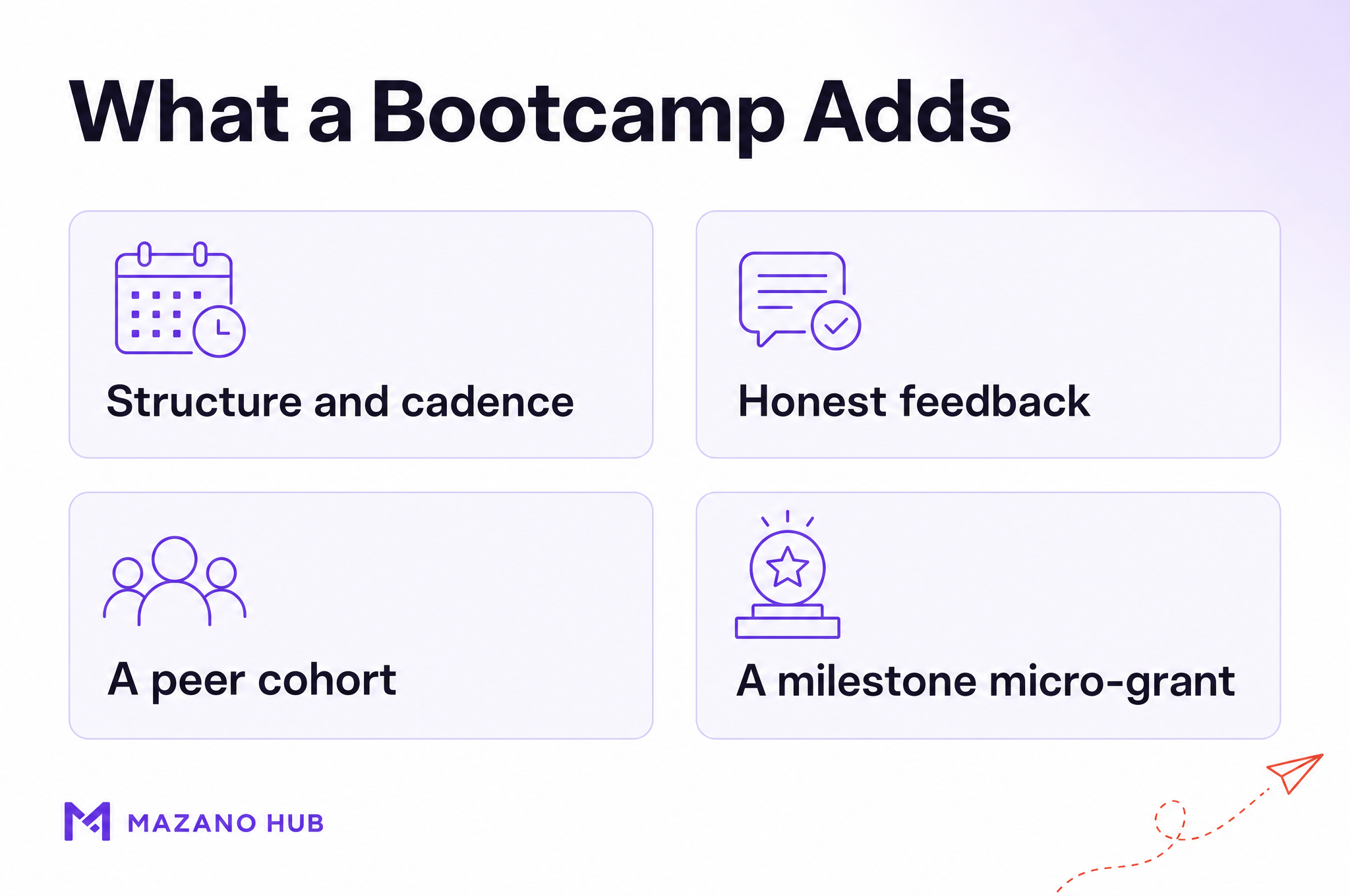
2. What Bootcamps Do That Self-Study CannotThree things distinguish a well-run bootcamp from a good online course or mentorship relationship on its own: cohort learning, structured feedback loops, and milestone-gated progression. Cohort learning puts founders in the room with peers facing the same stage of challenge at the same time. The conversations that happen between sessions — in hallways, over lunch, in group chats — produce insights no curriculum can manufacture. Founders debug each other's problems. They share supplier contacts, warn each other about regulatory pitfalls, and build the kind of trust that eventually becomes a business referral network. Structured feedback loops mean that progress gets evaluated, not just logged. Presenting a business model to a panel of mentors is a fundamentally different experience from writing it in a notebook. It surfaces assumptions the founder could not see from inside their own thinking. The feedback is immediate, specific, and repeatable — every few weeks, not once a year. Milestone-gated progression means that founders must demonstrate real progress before advancing. This is not gatekeeping — it is calibration. Founders who reach milestone 3 without completing milestone 2 tend to fail at milestone 4 in ways that are hard to recover from. Gating ensures the foundation is actually there. These three elements together produce something that self-study, informal mentoring, and individual coaching cannot individually replicate. They create a compressed, accelerated version of the first year of entrepreneurship — with support infrastructure in place to catch the hard falls. |
||
|
|
||
3. Why the African Context Demands This ModelAfrican founders operate in conditions that make the structured support model not just useful but necessary. Currency volatility, unreliable infrastructure, limited access to formal credit, and thin professional networks create a compounding disadvantage at every stage of venture building. The founders who survive these conditions are often the most capable people in the room — but capability alone does not overcome structural friction. Zimbabwe's context sharpens this further. With informal sector employment above 60% of the economy, the line between a side hustle and a scalable business is poorly understood, rarely tested, and almost never supported. Most aspiring entrepreneurs in Harare have no clear pathway from "I have an idea" to "I have a business model that has been stress-tested by people who know what to look for." Access to bootcamp programming in Sub-Saharan Africa has historically been concentrated in Lagos, Nairobi, Johannesburg, and Accra. Harare has been left out of that ecosystem. That is not a criticism of Harare's founders — it is an indictment of the infrastructure available to them. The talent is there. The structured support is not.
Faith-driven communities add another dimension specific to Zimbabwe's context. Church networks are some of the most trusted social infrastructure in the country. Founders who come through faith-based programs carry an additional layer of values alignment — accountability, integrity, servant leadership — that makes them more trustworthy to partners and investors. These are not soft benefits. They show up in retention rates, investor relationships, and community impact over time. |
||
|
|
||
4. What Mazano's Next Step Bootcamp Looks LikeThe Next Step Bootcamp is a 10-week intensive program for early-stage entrepreneurs at the idea, prototype, or early-revenue stage. It runs in-person at Mazano's 2,100-square-meter facility at 716 Maple Street, Sunway City, Harare — with a remote option available via video for founders outside Harare. The curriculum is built around the Next Step book series — a framework developed to take founders from concept validation through business model design, customer discovery, financial modeling, and pitch preparation. Each week focuses on a specific phase of the venture-building process. By week ten, every participant has a stress-tested pitch and a clear plan for the next six months. Mid-program, qualifying participants receive a Tier 1 micro-grant of $2,000–$5,000 to test their assumptions in the real market. This is not a prize — it is seed capital with milestones attached. Founders who have completed customer discovery and shown a viable revenue signal are eligible. The milestone gates ensure the grant lands at the right moment in the venture's development. Graduates who demonstrate post-program traction — revenue growth, team hires, market expansion — become eligible for Tier 2 scale grants of up to $50,000, and for introductions to Mazano's angel investor and VC network. The bootcamp is the entry point, not the ceiling. |
||
|
||
Applications reviewed on a rolling basis. Cohort 1 seats are limited. |