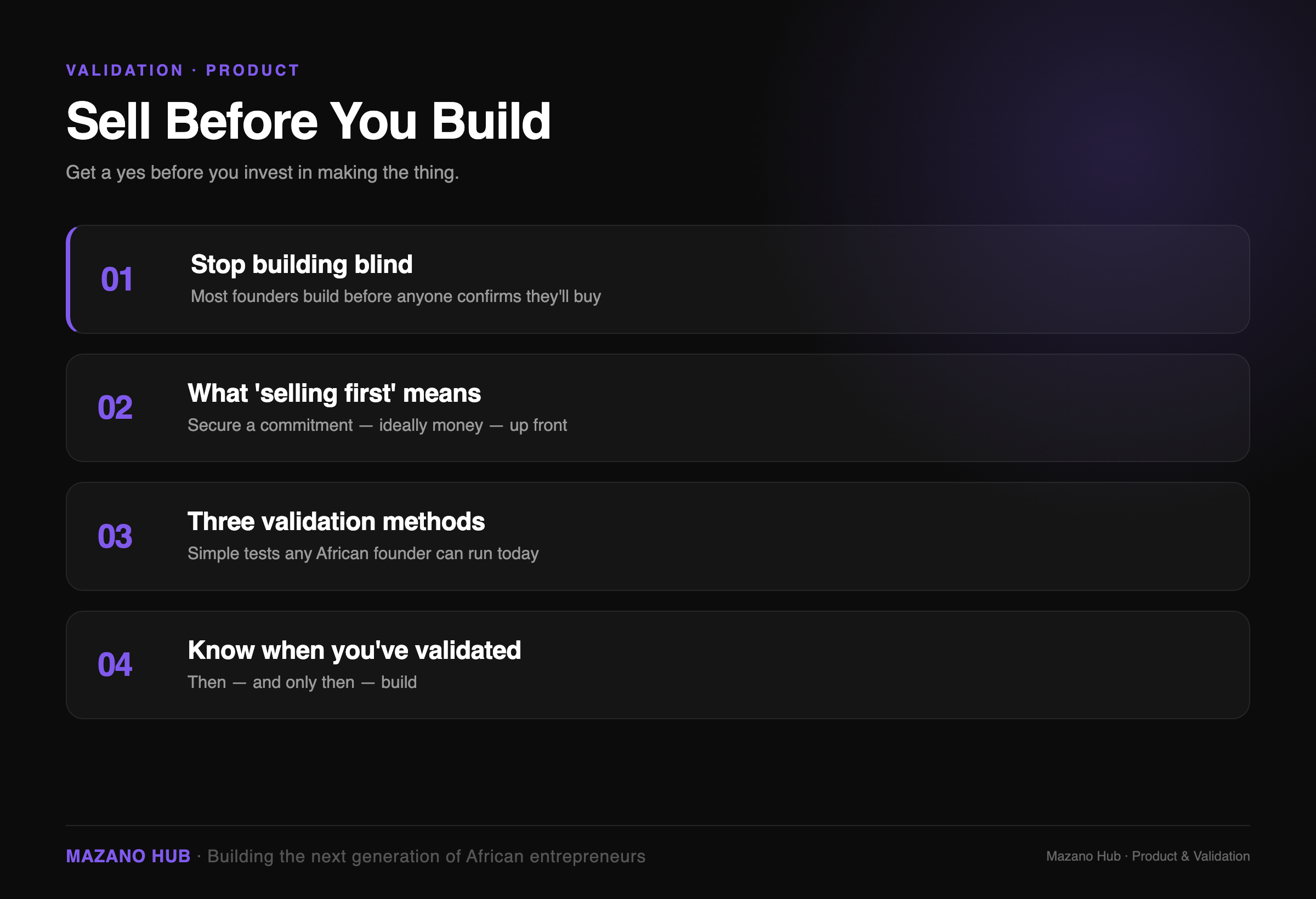
Sell Before You Build: A Guide for African FoundersValidating demand before you invest saves time, money, and heartbreak — here's how to do it in practice. |
|
|
One of the most common mistakes African founders make costs them nothing unusual to make — and everything to recover from. They spend months building a product or service in near-complete isolation. They invest savings. They borrow from family. They quit stable employment. Then they launch.
And the market does not respond the way they imagined. This is not a story about bad ideas. Many of these founders had real insight into genuine problems. But they skipped one critical step: proving that other people agreed the problem was worth paying to solve — before building anything. |
|
Why We Build Before We Know Anyone Will BuyThe instinct to build first is understandable. Building feels productive. Building feels safe — you're making something tangible, something you can show people. Pitching an unfinished idea feels presumptuous, even embarrassing. What if they say no? But this instinct is rooted in the wrong fear. The real risk is not that someone might say no to an early pitch. The real risk is spending six months and $2,000 building something only to discover that your target customer was already solving the problem some other way — or never intended to solve it at all. In resource-constrained markets like Zimbabwe — where inflation erodes savings month by month, where access to credit is limited, and where most founders are funding their ventures from personal income — building before validating is not just inefficient. It is dangerous. A wrong bet in a well-resourced market is a learning experience. In most African markets, it can end the business and set the founder back years. The shift required is not about confidence or courage. It is about sequence. Selling before you build means running the riskiest test first — not last. It means finding out whether the market will pay before you invest in production, development, or inventory. That is not pessimism. That is how durable businesses are built. |
|
What "Selling First" Looks Like in PracticeSelling before you build does not mean deceiving customers. It means testing the exchange — discovering whether someone will commit real resources (money, time, a signed letter) toward your solution before it is finished. This looks different depending on the business. A tailor in Harare announces a new line of work clothes via WhatsApp and asks for a 50% deposit before cutting fabric. Ten people pay. She now knows the demand is real. A tech founder pitches a bookkeeping app to three local shops — not as a demo, but as a real offer: "I will build this for $30 per month. Would you pay?" Two say yes and put it in writing. He builds. A training consultant approaches three corporations with a proposal for a financial literacy workshop. Before designing the curriculum, she asks each organisation to sign a letter of intent. Two sign. She designs. In every case, the founder made a real offer — specific, priced, and deliverable — and measured the response. The customers who said yes gave something more valuable than encouragement. They gave commitment. Commitment is the signal. Interest is not enough. Compliments are not enough. "This is a great idea" tells you nothing actionable. Money changing hands, a document signed, a name put to a promise — that is the signal you are looking for. Everything before that is noise. |
|
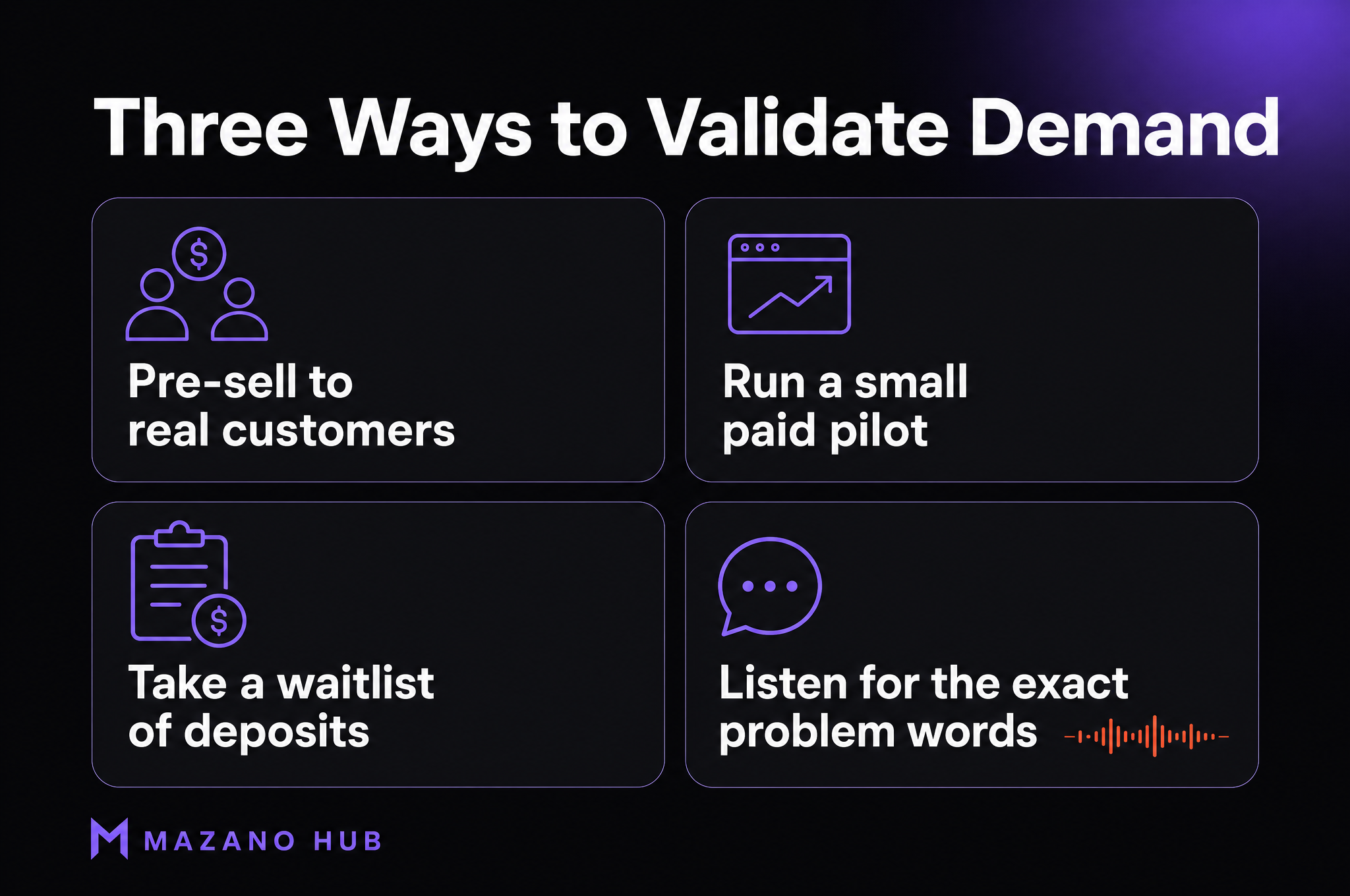
Three Validation Methods Any African Founder Can UseYou do not need a Silicon Valley network or a formal market research firm to validate demand. These three approaches work in African markets with minimal resources. 1. The Pre-Order Test Create the minimum credible version of your offer: a clear description, a price, and a delivery date. Share it directly with 20–30 potential customers via WhatsApp, in-person conversations, or a simple one-page document. Ask for a deposit. Do not build until at least five unrelated people have committed funds. This works best for physical products, training programmes, and professional services. The discipline here is making a real offer — not asking for opinions, but asking for money. 2. The Pilot Client Identify three to five businesses or individuals who have the problem you are solving. Offer to solve it for them at a reduced rate in exchange for their honest feedback and time. If you cannot find even three people willing to try your solution at a discount, that is important data. Pilot clients do not just validate demand — they shape your product. The first customers of any serious business are co-creators, not merely consumers. 3. The Letter of Intent For B2B solutions, a letter of intent (LOI) is one of the most powerful validation tools available to an African founder. It is not a contract, but it is a formal document in which a business says: "When your product is ready, we intend to buy." For grant applications, investor conversations, and incubator interviews, a stack of LOIs is more persuasive than any pitch deck. You can draft a simple one-page LOI template and approach local businesses directly. Many will engage if you have built any prior relationship or can demonstrate clear value. |
|
How to Know When You Have Validated EnoughThere is no fixed number. But there are clear signals. You have validated enough when at least three unrelated people have paid money or made a formal commitment. When you can describe your customer's core pain in their exact words — not your interpretation of it. When you know what they are currently using instead of your solution, and why they would switch. When you have heard a real objection and answered it to someone's satisfaction.
If you are still collecting "this is interesting" responses, you have not validated. Those are polite answers. They tell you nothing actionable. Validation is not comfort. It is not gathering supportive feedback. It is stress-testing the assumption that a specific group of people will part with their resources for a specific solution at a specific price. When you have three committed customers, a repeatable way to reach more of them, and a cost structure that allows the business to function — that is your green light to build. Not before. |
|
|
|
|