|
Mazano Hub Peer Learning Builds Zimbabwe's Strongest FoundersWhen entrepreneurs grow in community, they build businesses that last. May 19, 2026 • Mazano Hub Weekly |
|
|
There is a version of entrepreneurship that looks like this: one founder, one idea, one room, and years of figuring things out alone. It is the dominant experience for most early-stage entrepreneurs in Zimbabwe. And it is quietly expensive in ways that never show up on a balance sheet.
The founders who break through are rarely the ones who had the best idea first. They are the ones who found the right people to grow with—a cohort, a peer group, a structured community that held them accountable, challenged their assumptions, and celebrated their wins. That is the model Mazano was built on. And it is the model that Cohort 1 will prove. |
|
|
|
|
1. The Isolation TaxMost early-stage founders in Zimbabwe build in isolation. There is no structured feedback, no experienced peer to flag when a business model has a fatal flaw, no accountability partner to push back when the founder convinces themselves that the market will come eventually. The result is predictable: good ideas die quietly, not from bad execution, but from unchallenged assumptions. The isolation tax is real. Founders waste months pursuing product directions that a single honest conversation would have redirected. They price incorrectly because no one who has priced a product in their market sat across from them and said, “your margin assumption is wrong.” They miss obvious customer segments because no one pushed them to validate the ones they had not considered. In high-uncertainty markets like Zimbabwe—where hyperinflation, currency volatility, and shifting import conditions can change the fundamentals of a business overnight—the cost of building alone is even higher. The founder who has no one to call when the ZWL rate moves suddenly has to figure it out alone. Every time. The founder inside a cohort has five people who just dealt with the same thing. Isolation is not a character flaw. It is a structural gap. The answer is structural too. |
|
|
|
|
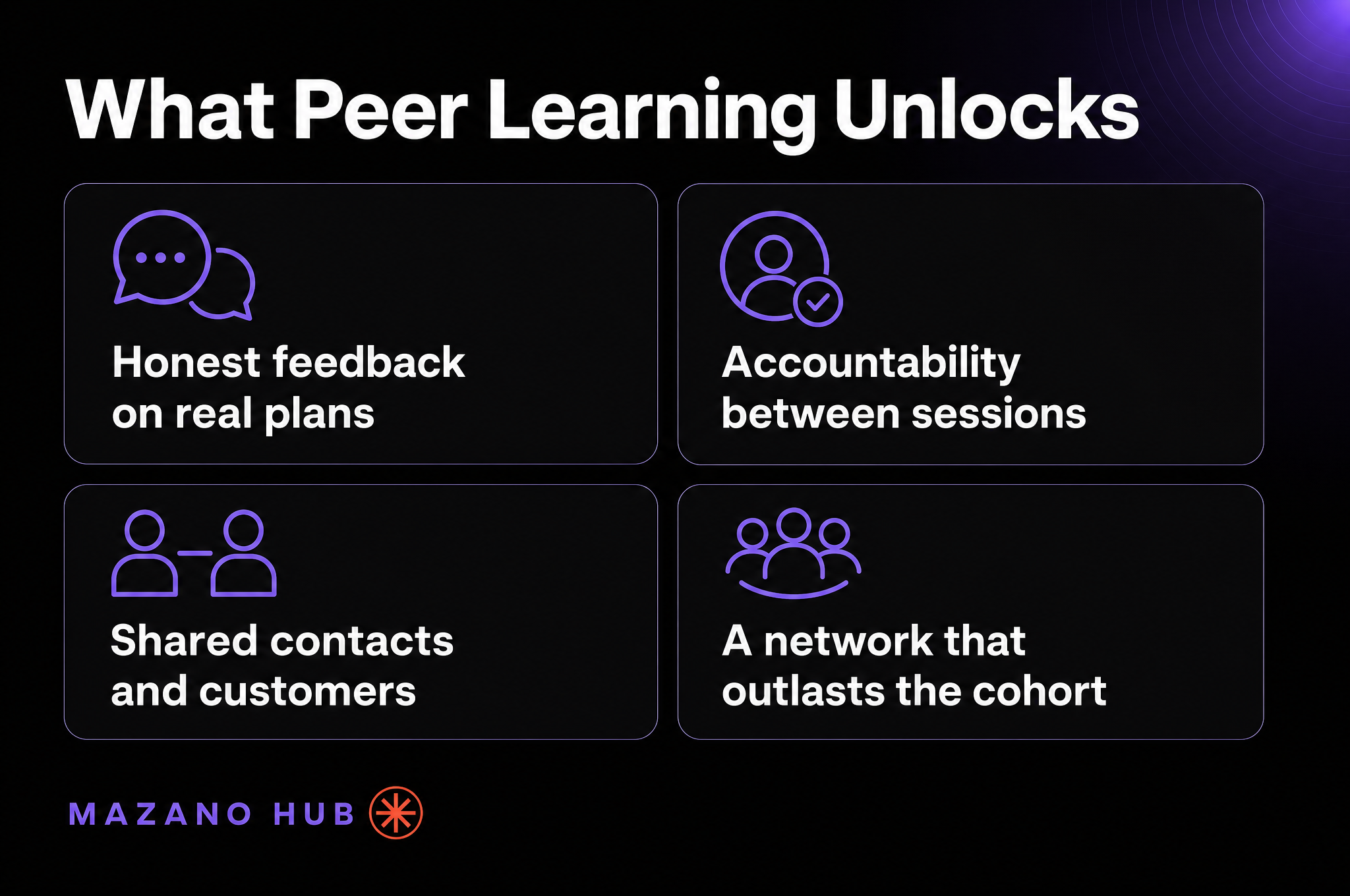
2. What Cohorts Actually Do for FoundersA cohort is not a class. It is not a networking event or a once-a-month meetup where founders exchange cards and forget each other's names by the parking lot. A real cohort is a structured commitment. People show up prepared. Milestones are set and reviewed. Progress is visible to the group. Gaps are named, not glossed over. The mechanics work because of accountability. When you know your peers will ask you next week if you did what you said you would do, you do it. Momentum is not a motivational concept—it is the product of showing up, week after week, inside a structure that expects your progress. That cadence forces founders to make decisions they would otherwise defer indefinitely. Curriculum matters too. Not because founders lack intelligence, but because structured curriculum sequences knowledge correctly. Customer discovery before product build. Pricing before scale. Revenue model before fundraising. Most founders learn these lessons in the wrong order—often because they got burned. A good cohort curriculum front-loads the hard lessons so founders do not have to pay full price to learn them. The final ingredient is honest feedback. Peers give feedback that mentors sometimes soften and investors always frame through their own bias. When a fellow founder tells you your pitch is unclear, you believe it. When a peer who has wrestled with the same market says your go-to-market is too slow, you adjust. That directness is one of the most valuable things a cohort produces. |
|
|
|
|
3. Zimbabwe's Founders Need Each OtherZimbabwe's entrepreneurial ecosystem has produced resilient founders. Decades of economic turbulence have produced a generation of business people who know how to improvise, survive, and adapt. That resilience is real and it is valuable. But resilience built in isolation has a ceiling. At some point, surviving is not enough. Scaling requires a different skill set. The skills that help a founder survive a 40% inflation rate—cash conservation, diversification, supplier negotiation—are not automatically the skills that help them build a team, enter a new market, or pitch an investor. The transition from surviving to scaling is where many Zimbabwean founders stall. And it is exactly where structured peer learning provides the most value. There is also a faith dimension that cannot be separated from this conversation. Zimbabwe's entrepreneurial culture is deeply connected to church and community. The model of growing together, carrying one another's burdens, celebrating together—this is not a business metaphor. It is a way of life that many Zimbabwean founders already know. The cohort model works so well here precisely because it maps onto existing cultural and spiritual instincts. Proverbs 27:17 is not a business slogan. It is a description of how iron sharpens iron—the friction of honest relationship producing a sharper edge. When Zimbabwe's founders grow together, they do not just build stronger businesses. They build a stronger ecosystem. Alumni networks that refer each other. Founders who back each other's ventures. A generation of entrepreneurs who carry a shared vocabulary of faith, accountability, and ambition.
|
|
|
|
|
4. Cohort 1 Is HereMazano's Next Step Bootcamp Cohort 1 is launching mid-2026 at the Harare facility on 716 Maple Street, Sunway City. For ten weeks, a selected group of early-stage Zimbabwean entrepreneurs will work through the Next Step curriculum together—in person, at a facility built for exactly this purpose. Participants will do real work. Customer discovery in week one. Revenue models by week four. Investor-ready pitches by week nine. And throughout every week: peer review, cohort accountability, and mentors who have built and scaled businesses in African markets. This is not a certificate program. It is a business-building environment. Cohort 1 participants who complete the program and demonstrate validated traction become eligible for Tier 1 micro-grants of $2,000–$5,000—zero equity, milestone-gated capital to test assumptions, build prototypes, and run first sales. The ones who graduate with strong metrics and continued growth enter the pipeline for Tier 2 graduate scale grants of up to $50,000. Mazano is actively recruiting Cohort 1 participants and seeking donors and church partners to fund the program infrastructure and micro-grant pool. Every dollar committed before cohort launch goes directly toward the first generation of Zimbabwe's faith-driven entrepreneurs learning to build together. This is not a future vision. Cohort 1 is here. |
|
|
|
Or visit mazano.org to learn how to support Cohort 1 as a donor or church partner. |
|
|