|
Something is shifting in the global economy — and it is shifting in Africa's favor.
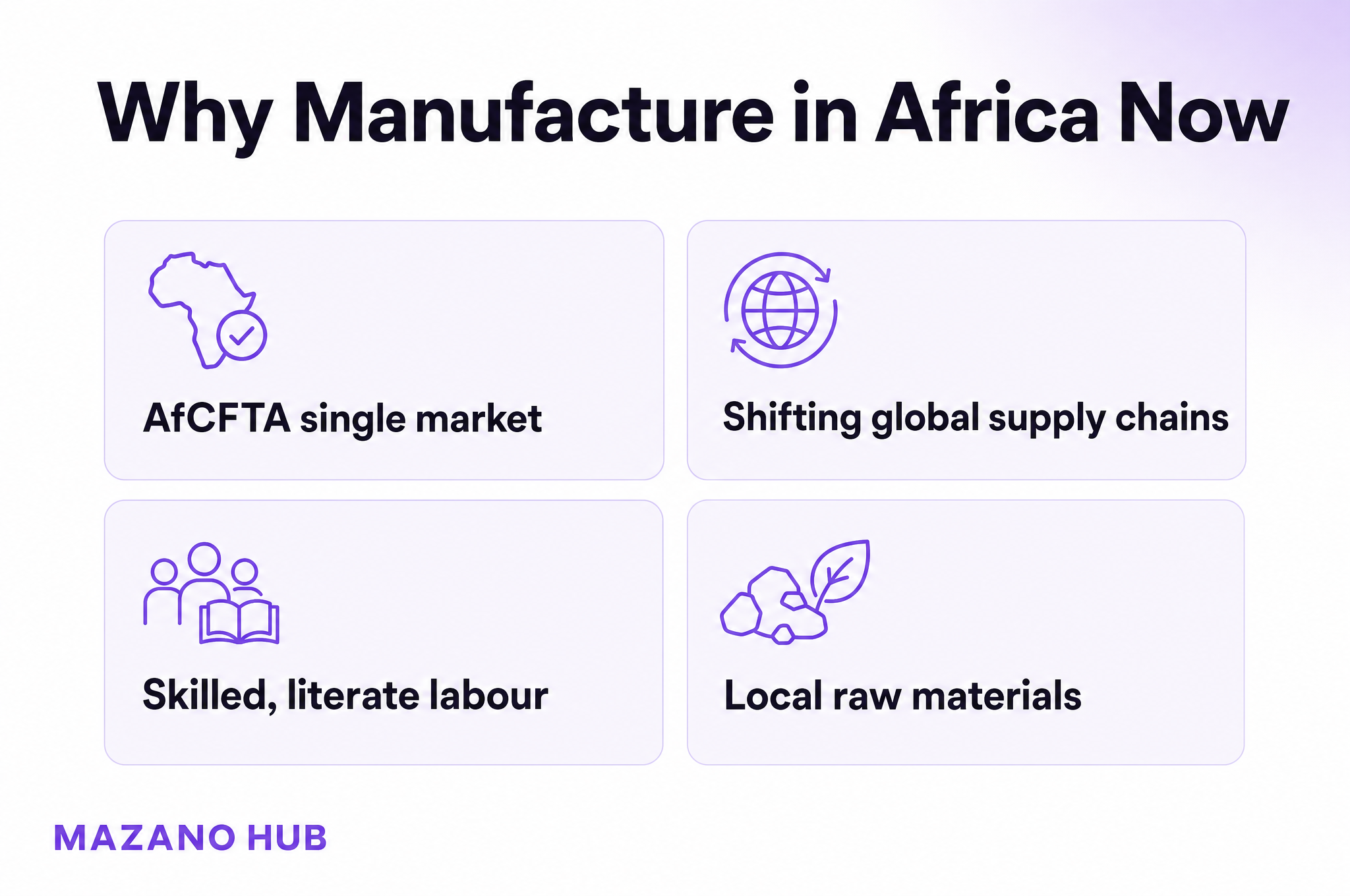
For decades, "made in Africa" described a fraction of what the continent consumed. Most goods arrived from Asia or Europe. Infrastructure gaps, capital scarcity, and limited market access kept African manufacturing at the margins. But 2026 looks different. Global supply chains are fracturing under trade pressures and geopolitical tension. Multinational companies are diversifying their production bases. And Africa — with a workforce of over 700 million and natural resources that the world depends on — is being looked at seriously for the first time in a generation.
The question is not whether Africa will manufacture more. The question is who will build the businesses that make it happen. At Mazano, we believe the answer starts with the entrepreneurs in our communities — equipped with skills, capital, and the conviction that they are called to build.
|
The Global Shift Is Happening Now
Section 1
|
In early 2025, the United States announced sweeping tariff adjustments targeting goods from major Asian manufacturing hubs. European supply chains, already strained by energy costs and logistical disruptions, began looking for alternative sourcing. The result: a scramble to identify where the next generation of reliable, cost-competitive manufacturing could be anchored.
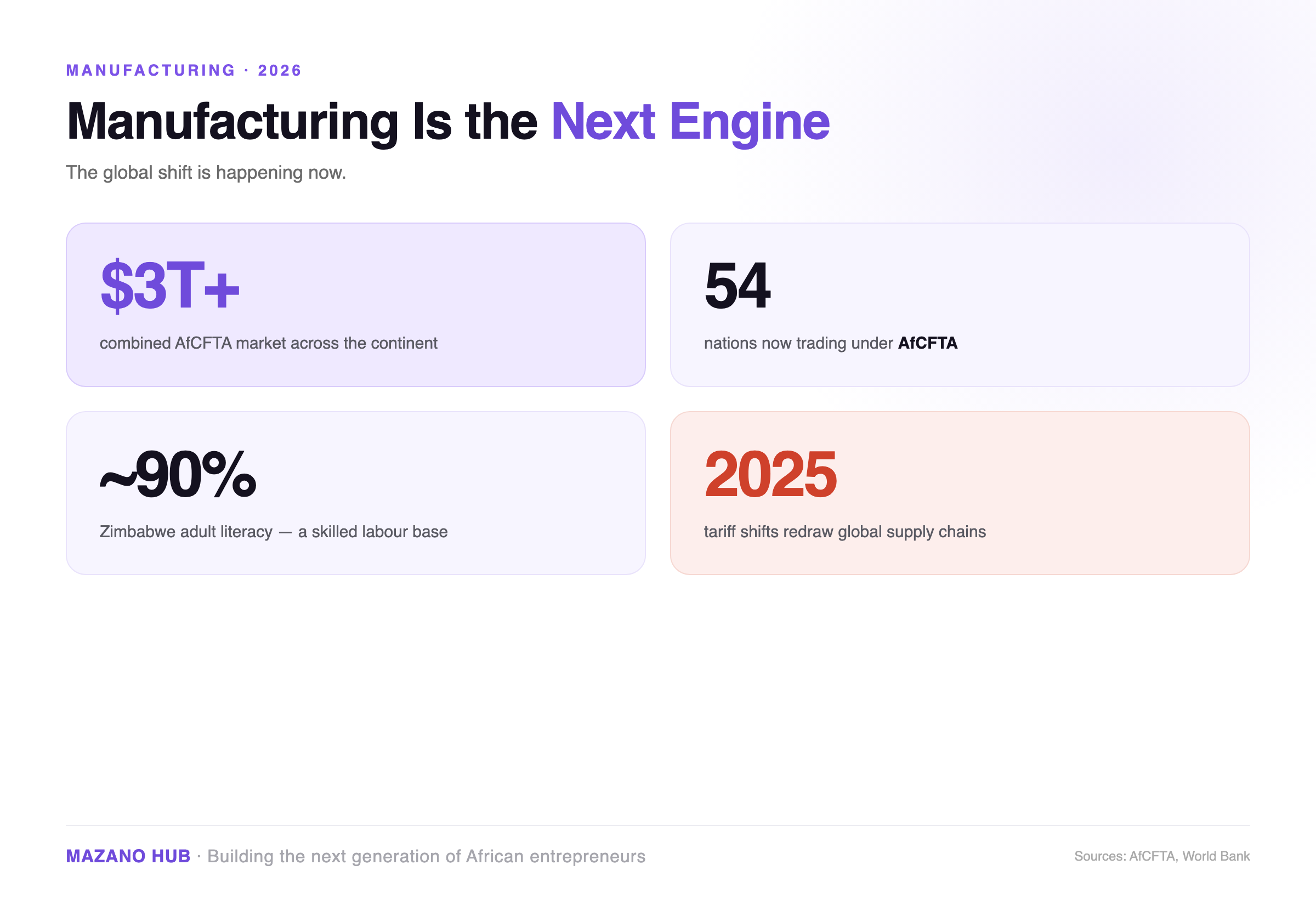
Africa entered these conversations for real. The African Continental Free Trade Area (AfCFTA), now operational across 54 nations, creates a $3.4 trillion market that makes regional manufacturing economically viable at scale. Countries like Ethiopia, Rwanda, South Africa, and Egypt are already attracting manufacturing investment. Zimbabwe, with its skilled technical workforce — one of the highest literacy rates on the continent — is in a position to compete, if the right infrastructure and talent support systems exist.
The window for African manufacturing leadership does not stay open forever. Historically, industrial transitions favor those who move decisively during the disruption phase — not after. We are in that phase right now. The entrepreneurs who start building today are the ones who will own the market when the dust settles.
This is not abstract economic theory. It is an operational reality for early-stage founders who are ready to build products, establish processes, and compete — not someday, but now.
|
Zimbabwe's Hidden Manufacturing Assets
Section 2
|
Zimbabwe has advantages that do not make headline news. The narrative about the country focuses, understandably, on economic hardship — hyperinflation, currency instability, sanctions. But underneath those headlines is a nation with assets that most manufacturers in the region would trade for.
Start with human capital. Zimbabwe's adult literacy rate hovers near 90%, among the highest in sub-Saharan Africa. The country has produced engineers, chemists, technicians, and skilled tradespeople for decades — many of whom are in the diaspora, willing to return if the opportunity is right. That workforce is a competitive advantage waiting to be activated.
Then there are the natural resources. Zimbabwe holds significant reserves of lithium — a critical input for the electric vehicle batteries the world is scrambling to produce. Chrome, platinum, gold, and diamonds. Agricultural land suited for agro-processing. A geographic location that gives access to both SADC and East African markets.
What Zimbabwe has lacked is a structured pipeline from idea to product — from the entrepreneur with a prototype to the business that manufactures at scale. Building that pipeline is not a government function alone. It is, in large part, the work of the entrepreneurship ecosystem. Incubators. Mentors. Early capital. Shared infrastructure. The ingredients are here. The assembly is what remains.
|
What's Blocking African Manufacturers Today
Section 3
|
Acknowledging opportunity does not mean minimizing the real barriers. Entrepreneurs in Zimbabwe and across Africa face a specific set of obstacles that stall manufacturing ventures before they gain traction. Understanding them clearly is the first step to solving them.
Capital gaps at the prototyping stage. Early-stage manufacturers need capital for equipment, raw materials, and iteration. This is the funding valley of death — too large for microfinance, too early for traditional investors. Most promising ventures stall here not because the idea is bad but because the first round of production capital is inaccessible.
Unreliable power and logistics infrastructure. Power outages, fuel costs, and transport challenges create overhead that eats into margins. Entrepreneurs who build around these constraints — using solar, decentralized production, or last-mile distribution models — have a real structural advantage over those who don't plan for them.
Market access and distribution. Building something is one challenge. Getting it to customers — especially at price points that work in USD-constrained local markets — is another. Regional distribution, export market entry, and B2B sales strategies require skills and networks most early founders haven't had the opportunity to develop.
These are real problems. But they are also solvable — with the right training, mentorship, and structured support. Every barrier above has been navigated by manufacturers in comparable contexts. The knowledge exists. The work is connecting entrepreneurs to it.
 Why Manufacture in Africa Now |
|
Building Builders: The Role of Incubators
Section 4
|
The data on incubation is consistent across contexts: structured support programs significantly increase the survival and growth rates of early-stage ventures. A 2024 ANDE (Aspen Network of Development Entrepreneurs) study found that African entrepreneurs who participated in formal incubation programs were 2.4 times more likely to still be operating after three years than those who did not. The mechanism is not magic — it is access: to mentors who have already solved the problems the entrepreneur is facing, to peer networks that hold founders accountable, to infrastructure that removes friction, and to frameworks that turn raw ambition into executable strategy.
For manufacturing entrepreneurs specifically, shared physical infrastructure matters enormously. Equipment access, prototyping space, and production facilities are cost-prohibitive for individual early-stage founders. Incubators that provide these as shared resources lower the entry barrier and allow ventures to iterate and validate before making large capital commitments.
At Mazano, we believe this support must also be rooted in values. The entrepreneurs who will build Zimbabwe's industrial future need more than business frameworks — they need the kind of character formation that sustains them through setbacks. Proverbs 24:16 says the righteous falls seven times and rises again. That resilience is not accidental. It is cultivated in communities that hold each other up, anchor identity in purpose beyond profit, and approach work as stewardship of what God has given.
That is the Mazano model. We are not building a transactional program. We are building an ecosystem — one cohort at a time — where manufacturing entrepreneurs come in with a vision and leave with the networks, skills, infrastructure, and faith-grounded resilience to execute it.
|
From Mazano Hub
Cohort 1 of the Mazano Next Step Bootcamp launches in Q2 2026 — and our Manufacturing & Technology Accelerator follows in Q3. We are actively recruiting early-stage founders in manufacturing, agro-processing, technology, and product development across Zimbabwe.
If you know a founder who should be in the room — refer them. If you are a donor, mentor, or partner who believes Africa's industrial moment is now, we want to hear from you. The entrepreneurs who will lead Zimbabwe's manufacturing future are already here. They need the ecosystem to meet them.
|
Apply for Cohort 1
Early-stage manufacturing and technology entrepreneurs in Zimbabwe — applications are open. 10-week intensive. In-person in Harare or remote. Equity-free.
Apply at mazano.org →
Questions? Reply to this email or write to [email protected]
|
|
Mazano Hub
716 Maple Street, Sunway City, Harare, Zimbabwe
mazano.org
|
[email protected]
You are receiving this because you are a supporter, partner, or subscriber of Mazano Hub.
Unsubscribe | Update preferences
|
|