Most African founders know their product better than anyone. They can describe the problem they solve, explain how their solution works, and tell you exactly who their customer is. But ask them for their cost to acquire a customer, and many go quiet.
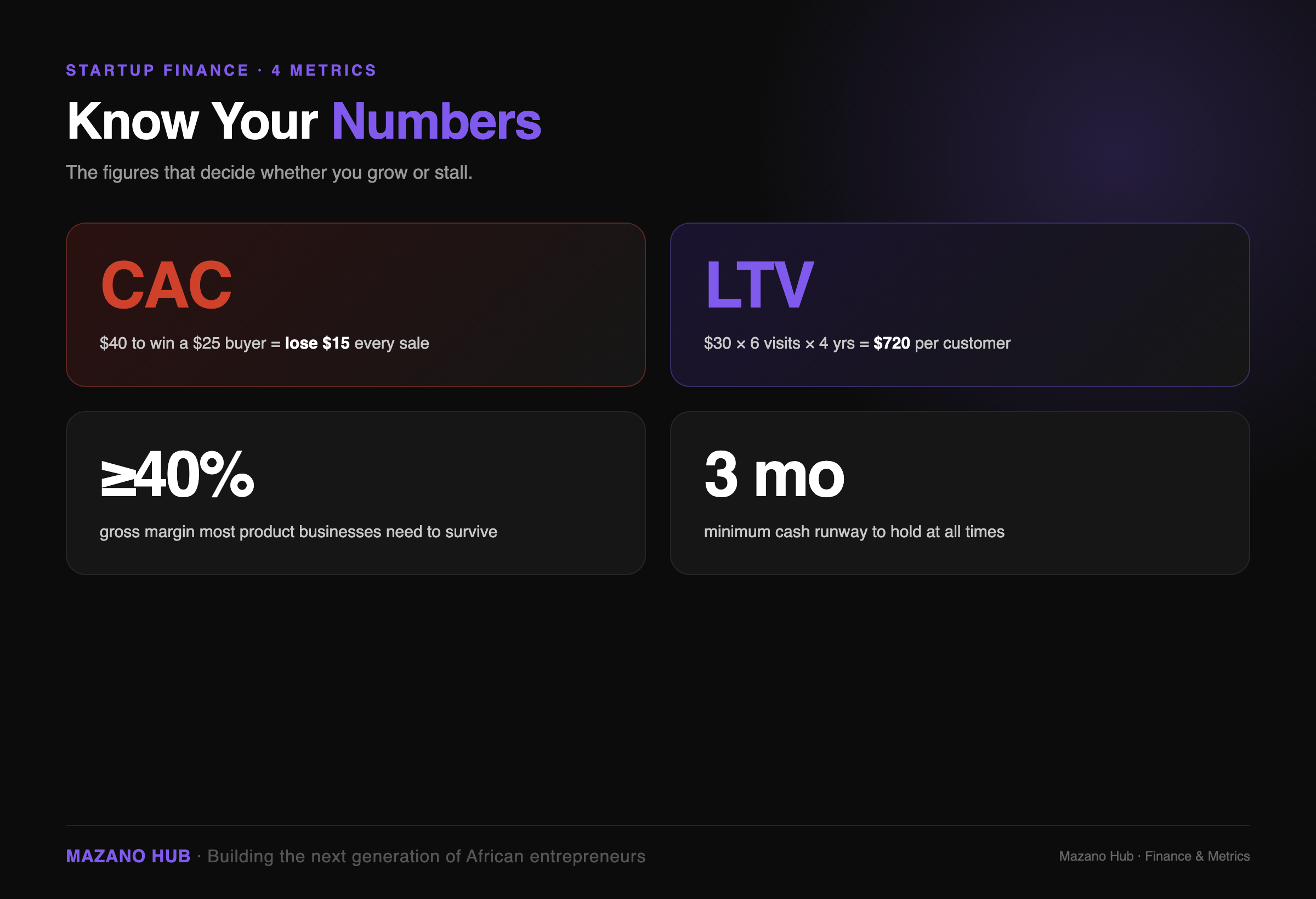 Four numbers every founder should be able to recite without looking. |
That silence is expensive.
You do not need an MBA to run a business. But you do need five numbers — five specific metrics that, together, tell you whether your business is building toward sustainability or quietly moving toward collapse. This week, we break each one down in plain language. No jargon. No spreadsheet required. Just the clarity every founder needs before they scale.
1. Cost to Acquire a Customer (CAC): What Are You Paying for Each Sale?
Your Cost to Acquire a Customer is the total amount you spend to bring one paying customer through the door. Add up everything you spent on marketing, advertising, promotions, sales staff, referral fees, and business development in a given month. Then divide that number by how many new customers you brought in that month. The result is your CAC.
Here is why this matters: many founders assume that because they are growing — more customers each month, more revenue coming in — the business is healthy. But if it costs you $40 to acquire a customer who only spends $25 with you, you are losing $15 on every single sale. The more you grow, the faster you burn your runway.
In Zimbabwe and across Sub-Saharan Africa, CAC is often higher than founders expect because informal referral networks — which feel free — are not actually free. They take time, relationship capital, and often small gifts or commissions. Count these. Track them. Knowing your real CAC is the first step to deciding where to invest your next marketing dollar.
A healthy business has a CAC that is at least three times smaller than what a customer is worth to you over their lifetime — which brings us to the next metric.
2. Lifetime Value (LTV): What Is One Customer Actually Worth?
Lifetime Value answers this question: from the moment a customer first buys from you to the moment they stop, how much revenue do they generate? To calculate it simply, multiply the average purchase value by how many times a customer typically buys per year, then multiply by the average number of years they stay with you.
For a small tailoring business in Harare, a loyal customer might spend $30 per visit, come in six times a year, and remain a customer for four years. That is $720 in lifetime value from one person. Suddenly, spending $50 to acquire them makes complete sense.
LTV teaches founders two critical lessons. First, not all customers are equal — some are worth ten times more than others, and knowing which customer types deliver the highest LTV helps you target your acquisition efforts more precisely. Second, retention is growth. Keeping an existing customer costs far less than finding a new one. Every founder who understands LTV invests more in customer experience, follow-up, and loyalty programs.
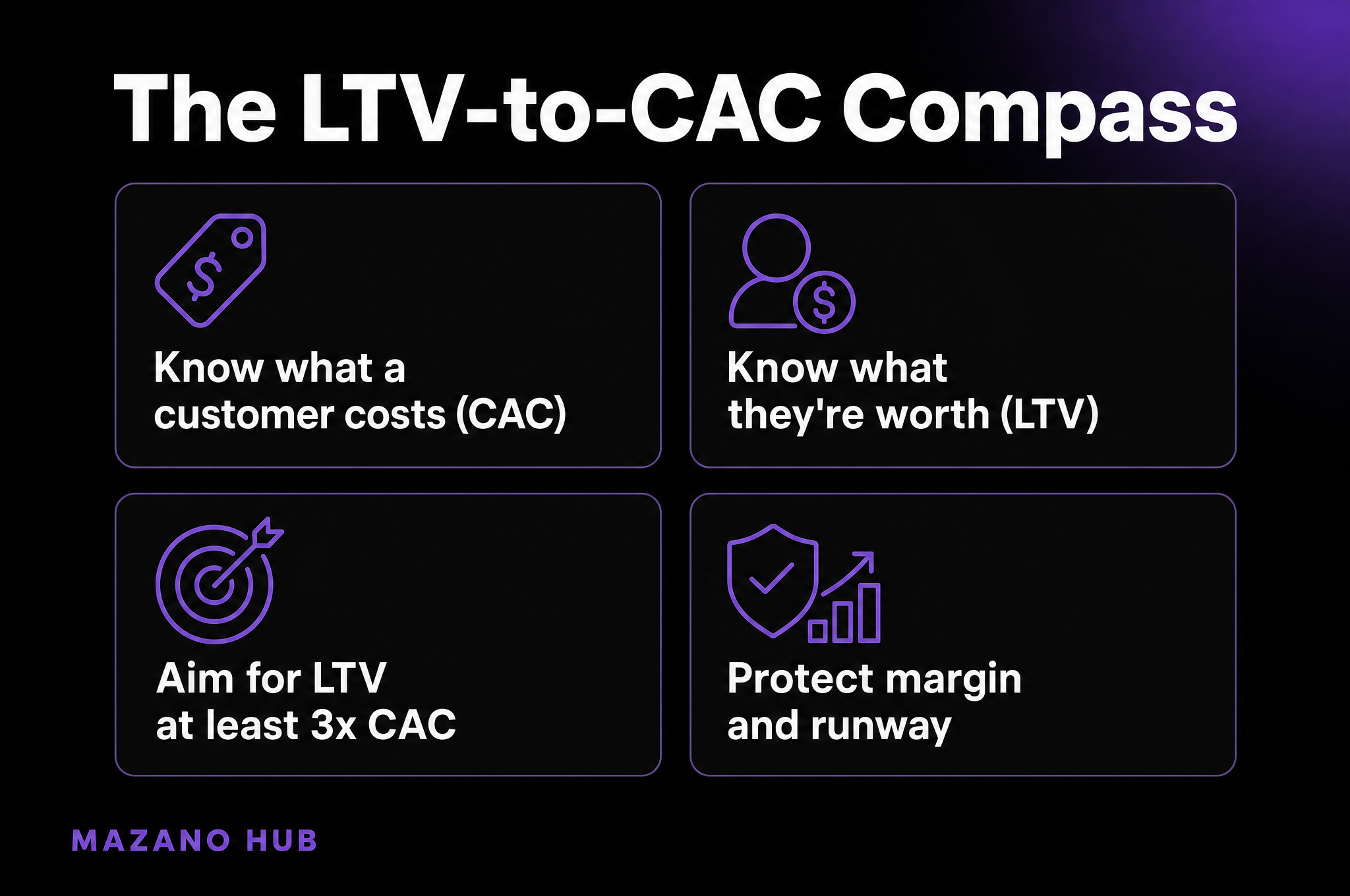
The LTV-to-CAC ratio is the golden compass of startup economics. If your LTV is at least 3x your CAC, your business model is fundamentally sound. Below that, you need to rethink either your pricing or your customer acquisition strategy.
3. Gross Margin: Are You Actually Making Money on What You Sell?
Revenue is not profit. This is the lesson that breaks many first-time founders. Gross margin is the percentage of each sale that remains after you subtract the direct cost of delivering your product or service — what accountants call Cost of Goods Sold (COGS). If you sell a bag for $50 and it costs you $35 to source, package, and deliver it, your gross margin is 30%.
A 30% gross margin sounds reasonable. But once you subtract your rent, staff salaries, phone data, transport, and the time you spent running the business, that 30% can vanish entirely. Founders in African markets often undercount COGS because many costs are paid informally — transport in cash, supplies from a relative's shop, storage in a family home. Every one of these costs belongs in your calculation.
Most viable product businesses need gross margins of at least 40–50% to cover operating expenses and remain profitable. Service businesses can often reach 60–80%. If your margins are too thin, the solution is almost always one of three things: raise prices, reduce direct costs, or change your product mix to emphasize higher-margin offerings.
Gross margin is also the number investors look at first when evaluating whether a business can scale. High margins create headroom to invest in growth. Thin margins trap founders in a cycle of high volume and low reward.
4. Burn Rate and Runway: How Long Does Your Business Have to Survive?
Burn rate is how much money your business spends each month beyond what it brings in. If you have $2,000 in the bank and you are spending $500 more than you earn each month, your runway is four months — four months until you run out of cash and cannot operate.
 The LTV-to-CAC Compass |
Most early-stage founders in Zimbabwe are not venture-backed with large cash reserves. Their runway is lean by design — they rely on revenue to cover costs, and a slow sales month can cascade into a genuine crisis. This makes knowing your burn rate not just useful but essential for survival.
The discipline here is simple: know your number. Every Friday, check your bank balance against your monthly costs. Are you trending toward positive cash flow this month, or are you drawing down? Founders who watch this number weekly make better decisions — they delay a non-critical purchase, they push to collect a late payment, they decide to run a promotion to accelerate revenue.
A healthy target: always have at least three months of runway available. If you dip below that, treat it as an emergency signal. Cut discretionary costs immediately and accelerate sales activity. Founders who wait until they have one month of runway left rarely survive to tell the story.
The Mazano Angle: Cohort 1 Founders Will Know Their Numbers
At Mazano, financial literacy is not an advanced module — it is the foundation. Every founder entering Cohort 1 will leave with a working grasp of their CAC, LTV, gross margin, burn rate, and growth trajectory. Not as theory. As live data from their own businesses.
When a founder can walk into a room with a potential partner, donor, or investor and say "My LTV-to-CAC ratio is 4.2, my gross margin is 58%, and I have six months of runway" — that founder is taken seriously. That conversation looks different. The outcome changes.
Mazano Cohort 1 is preparing to launch mid-2026. If you are a Zimbabwe-based entrepreneur who is building something real and ready to do the work of understanding your business at depth, the application window is open. We are looking for founders who are coachable, committed, and serious about building enterprises that last.
|
Applications Open Apply to Mazano Cohort 1Faith-driven entrepreneurship incubator launching mid-2026 in Zimbabwe. Limited spots available. Apply at mazano.org → |
MAZANO HUB
Empowering African entrepreneurs through faith-driven incubation.
mazano.org | Unsubscribe | Update Preferences
© 2026 Mazano. You are receiving this because you subscribed at mazano.org.