|
Picture a founder who wakes up on a Monday to discover that the currency she priced her products in on Friday has lost eight percent of its value over the weekend. Her supplier invoices are in USD. Her customers pay in ZWL. Her payroll is due on Wednesday. She has exactly one hour before she needs to open the shop.
She adjusts her prices, calls her most trusted supplier to renegotiate a three-day extension, and opens on time.
This is not a crisis story. This is Tuesday in Zimbabwe. And the founder who navigates it with composure, creativity, and a clear head has developed something that no accelerator program, no startup bootcamp, and no business school curriculum fully teaches: genuine economic resilience. At Mazano, we believe the entrepreneurs who will build Zimbabwe's next chapter are not waiting for stable conditions. They are already operating — sharpened by pressure, grounded by faith, and ready to scale.
|
|
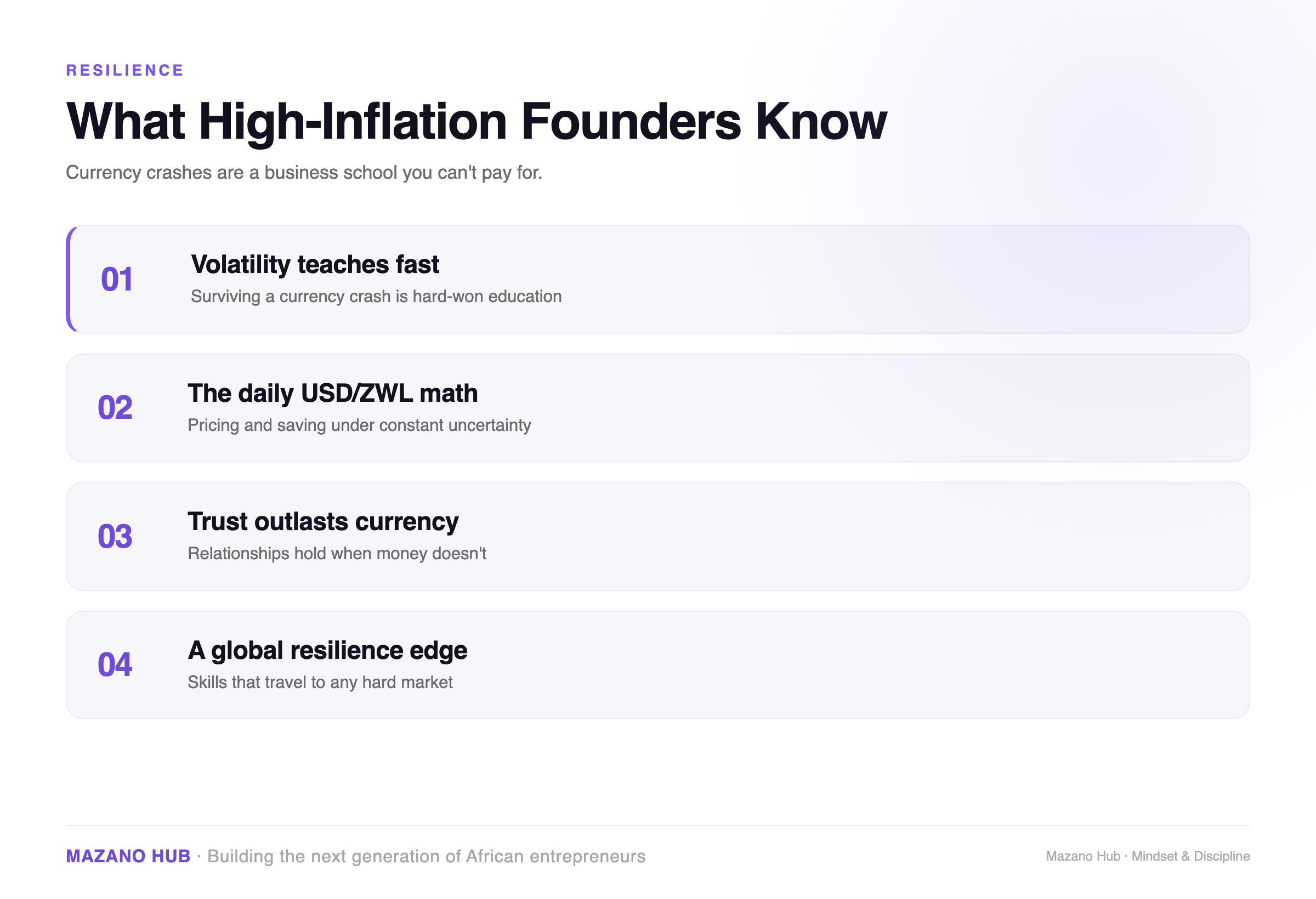
Currency Crashes Are Business School You Can't Pay For
Zimbabwe's inflation history is well documented — and relentlessly discussed in international development circles, usually as evidence of dysfunction. But inside that story is a different truth: decades of currency volatility have produced a generation of entrepreneurs with financial literacy that is, in practical terms, extraordinary.
When your operating environment changes faster than a quarterly budget cycle can account for, you stop planning in spreadsheets and start thinking in scenarios. You develop a granular, real-time sense of cash flow. You learn to distinguish between nominal revenue and real purchasing power. You stop confusing profit on paper with liquidity in hand. These are not abstract financial concepts — they are survival skills, learned through practice, tested daily.
The same instincts that allow a Harare market vendor to remain solvent across a currency crisis are the instincts that allow a growth-stage startup to maintain runway through an investor drought. The contexts are different. The cognitive muscle is identical.
Global business educators are beginning to notice. Emerging-market resilience is increasingly cited as a competitive trait — not a disadvantage to be overcome, but a capability to be deployed. Zimbabwean founders carry this fluency natively.
|
|
USD or ZWL? The Daily Math of a Zimbabwean Founder
Walk into almost any business in Harare today and you will find a founder mentally operating in at least two currencies simultaneously. Supplier relationships are priced in USD — a de facto standard that provides stability on the cost side. Customer transactions often settle in ZWL, the domestic currency, whose exchange rate against the dollar shifts on a timeline that can be measured in hours, not days.
The mental model required to sustain this is sophisticated. A founder must know, at any given moment, not just what her product costs and what she is charging — but what her USD-equivalent margin is, what the rate is today versus yesterday, and whether delaying a transaction by 24 hours would materially change the economics. This is not back-of-napkin calculation. It is applied financial management, executed in real time, without a finance team.
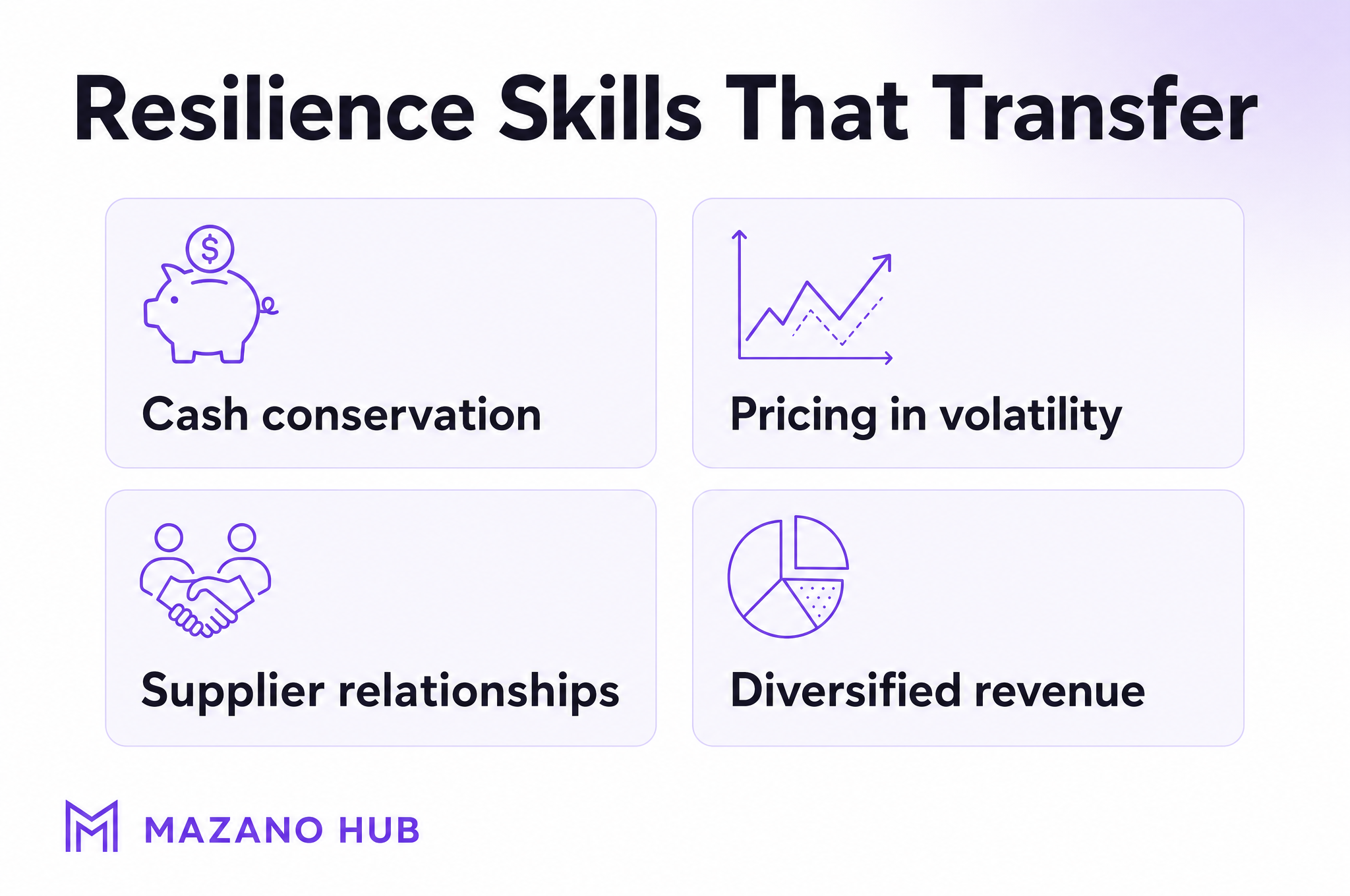
And it does not stop at pricing. Payroll management in dual currencies requires creative structuring. Inventory decisions are made with one eye on exchange-rate forecasts. Supplier negotiations are won or lost on timing as much as volume. The Zimbabwean founder who navigates these dynamics routinely has developed a pricing acuity and financial intuition that most formal business environments never demand.
These are not theoretical skills. They are transferable skills — the kind that make for exceptional operators when capital and stable conditions eventually arrive.
|
|
The Trust Economy: Relationships Outlast Currency
When currency becomes unreliable, communities build alternative systems of exchange. Across Zimbabwe's informal and semi-formal economy, relationships function as the primary medium of credit. A supplier extends a 30-day payment window not because of a credit score, but because of a decade of consistent dealing. A customer prepays not because of a contractual obligation, but because trust has been established through repeated, honest transactions.
This is the trust economy — and it is one of the most durable competitive advantages a founder can build. In an environment where formal financing is limited, where banking access is inconsistent, and where institutional credit infrastructure remains underdeveloped, social capital becomes the real store of value.
For Mazano, this is not just an economic observation. It is a biblical one. Stewardship, integrity, and faithfulness to one's word are not soft values — they are strategic assets. The Proverbs principle that a good name is more desirable than great riches is not merely aspirational. In a high-inflation environment, it is empirically true. The founder with a good name survives the crash. The one who cut corners does not.
Mazano's curriculum is built on this understanding. We do not simply teach business mechanics. We teach founders to build the kind of character that outlasts every economic cycle. Because in Zimbabwe — and in every emerging market — the entrepreneur who is trusted is the entrepreneur who endures.
 Resilience Skills That Transfer |
|
|
A Training Ground for Global Resilience
The global startup ecosystem has a resilience problem. Founders who have only ever operated in stable, low-inflation economies are structurally unprepared for the volatility that defines most of the world's markets. When the next economic shock arrives — and it always does — the operators who hold together are the ones who have already been tested.
Zimbabwe's founders have been tested. Repeatedly. And a growing number of international investors and impact funders are beginning to recognise what that means. The African Continental Free Trade Area is opening cross-border market access. Zimbabwe's diaspora — one of the most educated in Africa — is increasingly channelling capital and mentorship back home. The infrastructure for a genuine entrepreneurship ecosystem is assembling.
What has always been present is the human capital. Founders who can price in three currencies, manage supplier relations without credit facilities, build community trust as a business moat, and remain operational through power outages, currency crashes, and supply chain disruptions — these are not disadvantaged entrepreneurs. They are exceptionally prepared ones.
The world is beginning to catch up to what they already know. Mazano exists to give those founders the structure, the network, and the capital to take the next step — and to carry Zimbabwe's entrepreneurial resilience into the markets it deserves to reach.
|
|
The Mazano Angle
Cohort 1 launches in Q2 2026 at 716 Maple Street, Sunway City, Harare. The founders who will walk through those doors are not blank slates. They are survivors and builders who have already operated under conditions most business curricula never simulate.
Mazano's role is not to install resilience in them. It is to meet them where they are — with the Next Step Bootcamp curriculum, with mentors who understand their context, with seed capital structured to unlock the next phase of growth, and with a community anchored in faith-driven values. What they already have is extraordinary. What they lack is access. That is the gap we exist to close.
|
|
Applications for Cohort 1 are open. If you are an early-stage founder — or if you know one — now is the time.
Apply at mazano.org
|
|
|
Mazano Hub
716 Maple Street, Sunway City, Harare, Zimbabwe
mazano.org
|
[email protected]
You are receiving this because you subscribed to the Mazano Hub newsletter.
| Unsubscribe
|
|