There is a particular kind of founder you meet across Zimbabwe and the broader African continent. She runs a small tailoring cooperative in Gweru. He manages a logistics depot in Chitungwiza. They're not splashed across Forbes lists. No Series A. No Y Combinator batch. But their businesses survive. Year after year, they hold on — and quietly grow.
Ask them what holds the enterprise together and the answer rarely starts with product-market fit or margin optimization. It starts with values. With accountability to something larger than the balance sheet. This is not anecdote. The evidence is accumulating: businesses built on clear moral frameworks — stewardship, honesty, servant leadership — demonstrate measurably stronger retention, community trust, and long-term resilience. For African founders operating in high-volatility environments, faith-driven principles are not a soft addition to business strategy. They are the strategy. |
||
|
|
||
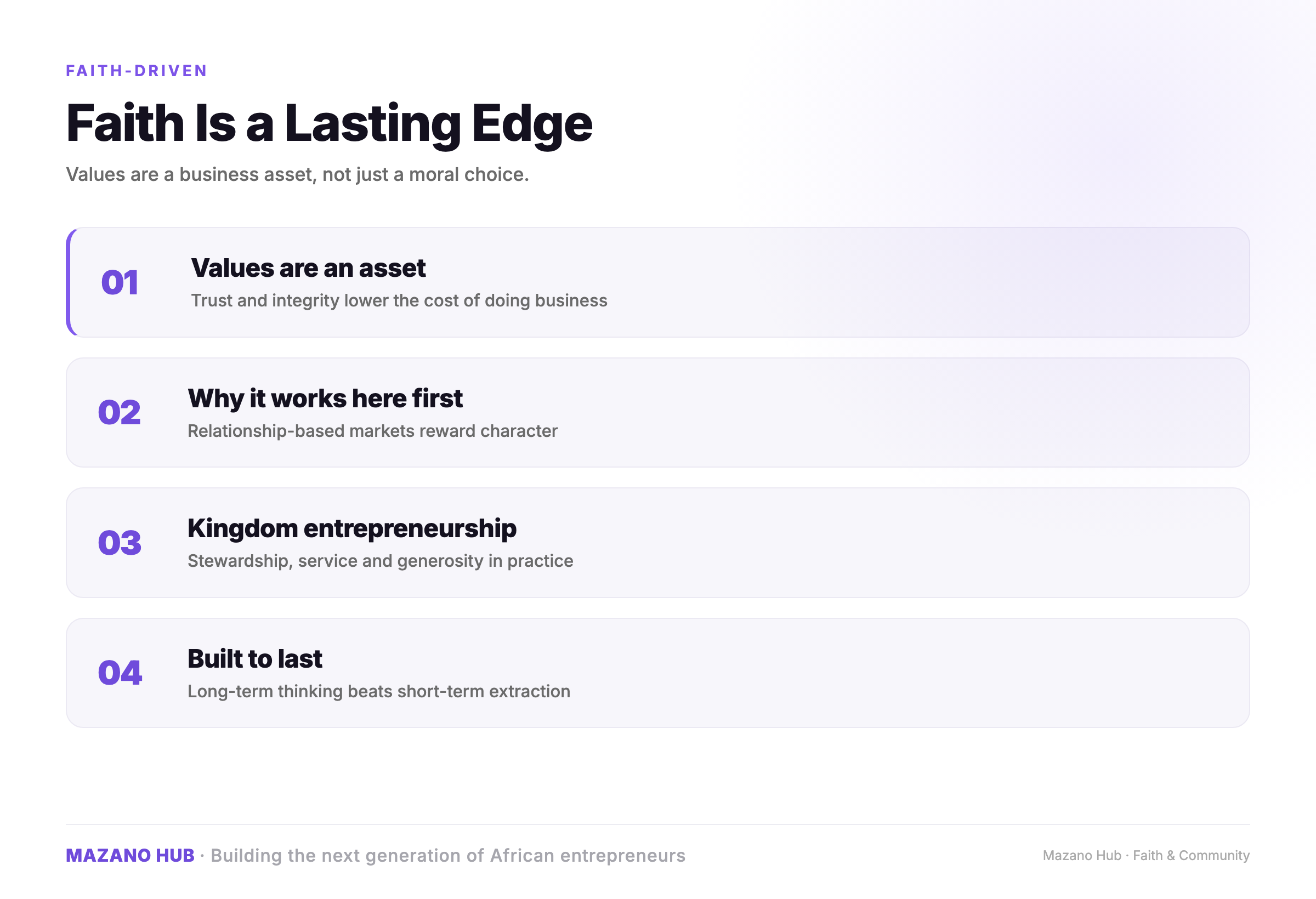
Why Values Are a Business Asset, Not Just a Moral ChoiceStrip away the language of faith for a moment and examine what these principles actually produce at the operational level. Stewardship means treating resources — capital, people, time — as something to be multiplied responsibly rather than consumed quickly. In practice this produces lower burn rates, more deliberate hiring decisions, and better supplier relationships. Honesty in contracting reduces legal exposure and builds the kind of reputation that lowers customer acquisition costs over time. Servant leadership creates employee cultures where people stay, perform, and recruit others like themselves. A 2022 study by Africa Business Insights found that SMEs led by founders who explicitly cited ethical or faith-based principles in their decision-making reported 34% higher five-year survival rates compared to peer businesses in the same sectors. The study attributed this primarily to supplier trust relationships and lower staff turnover — both outputs of how the founders treated people, not products. This is what the investment community often misses when it evaluates African early-stage businesses. A founder's values system is a leading indicator of operational performance. It shapes how they navigate cash flow crises, how they respond to regulatory pressure, and whether their first hire becomes their fifth. Capital can fund a business. Character sustains it. The global conversation about ESG — environmental, social, and governance standards — has begun encoding some of these insights into institutional investment criteria. But African founders operating from a faith framework have been practicing this for decades without needing the acronym. The difference now is that the language exists to articulate what was already working. |
||
|
|
||
The African Context: Why This Works Here FirstZimbabwe's informal economy accounts for over 60% of all economic activity. Currency instability, sanctions history, and constrained FDI mean that most early-stage founders cannot rely on the institutional scaffolding that supports entrepreneurs in more stable markets. There is no safety net of venture debt or government-backed SME loan guarantees at scale. What exists instead is community — church networks, family networks, neighborhood networks — and the reputation you carry within them. In this environment, community trust is not a brand strategy. It is the actual distribution channel. The tailor whose church network refers clients. The logistics operator whose pastor vouches for his reliability to a new corporate account. The women's cooperative whose members hold each other accountable to delivery timelines because the group's collective reputation is on the line. This is faith-driven enterprise functioning as infrastructure. Africa's population exceeds 1.4 billion, with more than half under the age of 25. The next generation of African entrepreneurs is growing up in a context where formal institutions are often absent or unreliable. They are not building in a vacuum of values — they are building in a vacuum of systems. Faith provides a portable, scalable framework for decision-making that does not depend on which government is in power or which currency is in use. This is why the faith-driven entrepreneurship model is not an import from Western Christian business culture. It is indigenous to how communities on this continent have organized productive activity for generations. The innovation is in formalizing it, teaching it, and connecting it to modern business skills — so that what works in a church cooperative can also work in a tech startup or a manufacturing enterprise. |
||
|
|
||
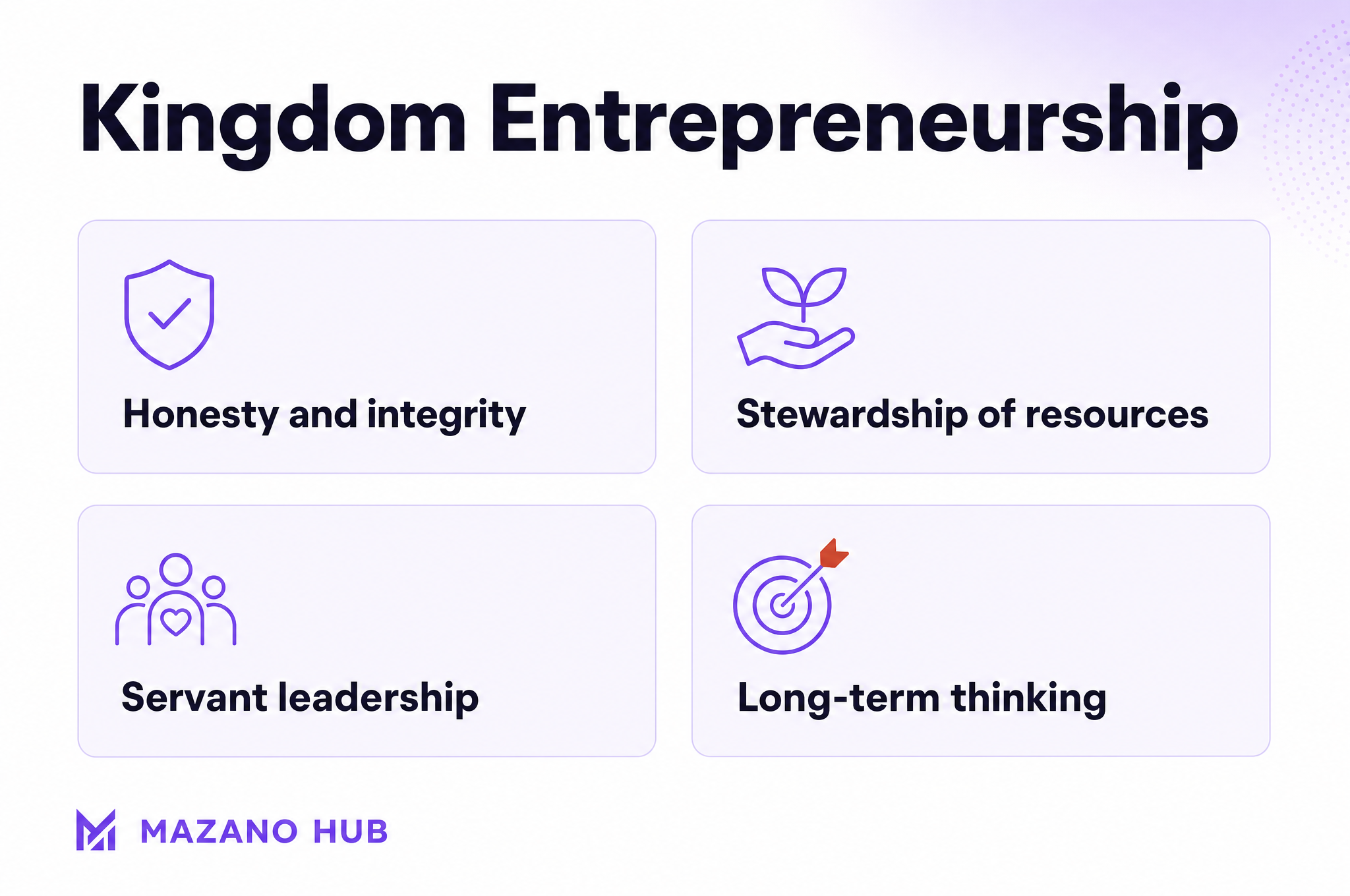
What Kingdom Entrepreneurship Looks Like in PracticeKingdom entrepreneurship is not a separate category of business. It is a way of running any business. The principles apply whether the venture is a food processing startup, a software firm, or a garment manufacturing operation. The question is not what industry you are in — it is what operating values you bring to it. Stewardship in practice looks like this: before spending a dollar, a founder asks whether this expenditure multiplies value for the people the business serves. It is not austerity for its own sake. It is intentionality — a commitment to using resources as a trust, not a reward. In a hyperinflationary environment like Zimbabwe, where the Zimbabwean dollar has lost 40–50% of its value annually, founders who practice financial stewardship build reserves, hedge in USD-denominated assets, and survive shocks that bankrupt less disciplined peers. Honesty in practice means contracts that say what they mean, pricing that does not exploit information asymmetry, and quality commitments kept even when no one is watching. It means telling an investor the truth about a setback instead of managing the narrative. This is harder in the short term. It is significantly more valuable over a five-year horizon.
Servant leadership in practice means that the founder is the last to eat. It means building a team culture where people solve problems rather than escalate them, because they know the leader is working for their success. Businesses run this way scale differently — not faster necessarily, but more stably, because the people inside them are genuinely invested. When staff turnover is low and morale is high, you do not need to rebuild your operational knowledge base every eighteen months. |
||
|
|
||
Mazano Cohort 1: Building the Next Generation of Faith-Driven FoundersMazano Hub's first cohort launches in Q2 2026 at our Harare facility — 2,100 square meters of co-working space, conference rooms, and workshop infrastructure powered by off-grid solar and Starlink satellite internet. The Next Step Bootcamp is a 10-week intensive built around the Next Step book series, which integrates Biblical principles with practical business skills: financial management, product development, sales strategy, team building, and investor readiness. The curriculum does not treat faith as a separate module. It is woven into the framework throughout — because that is how it works in practice. A session on cash flow management also covers stewardship. A session on team culture also covers servant leadership. A session on negotiation also covers honesty. The goal is not to produce entrepreneurs who are Christian by label and conventional in behavior. It is to produce founders whose business decisions are genuinely shaped by what they believe. Cohort 1 is open to aspiring entrepreneurs, early-stage startups, SMEs looking to scale, faith-based organizations launching community ventures, and youth and women entrepreneurs across Zimbabwe. Participants can attend in person at the Harare site or remotely via video link. Selected participants receive access to equity-free seed support, mentor introductions, and the Mazano investor and church partner network. This is not a seminar or a motivational program. It is a structured incubation with accountability, mentorship, and real resources. If you know a founder in Zimbabwe — or in the diaspora — who is building something with both ambition and values, this cohort exists for them. |
||
|
||
|
|
||
|
Mazano Hub 716 Maple Street, Sunway City, Harare, Zimbabwe You are receiving this because you subscribed to Mazano Hub updates. Unsubscribe |