|
There is a founder in Bulawayo who posts every Friday about his week — what worked, what failed, what he learned, what he is building next. He has 900 LinkedIn followers. No venture capital. No co-working office. But he has landed two paying clients, one international mentor, and a government contract inquiry — all from people who found him through those weekly posts.
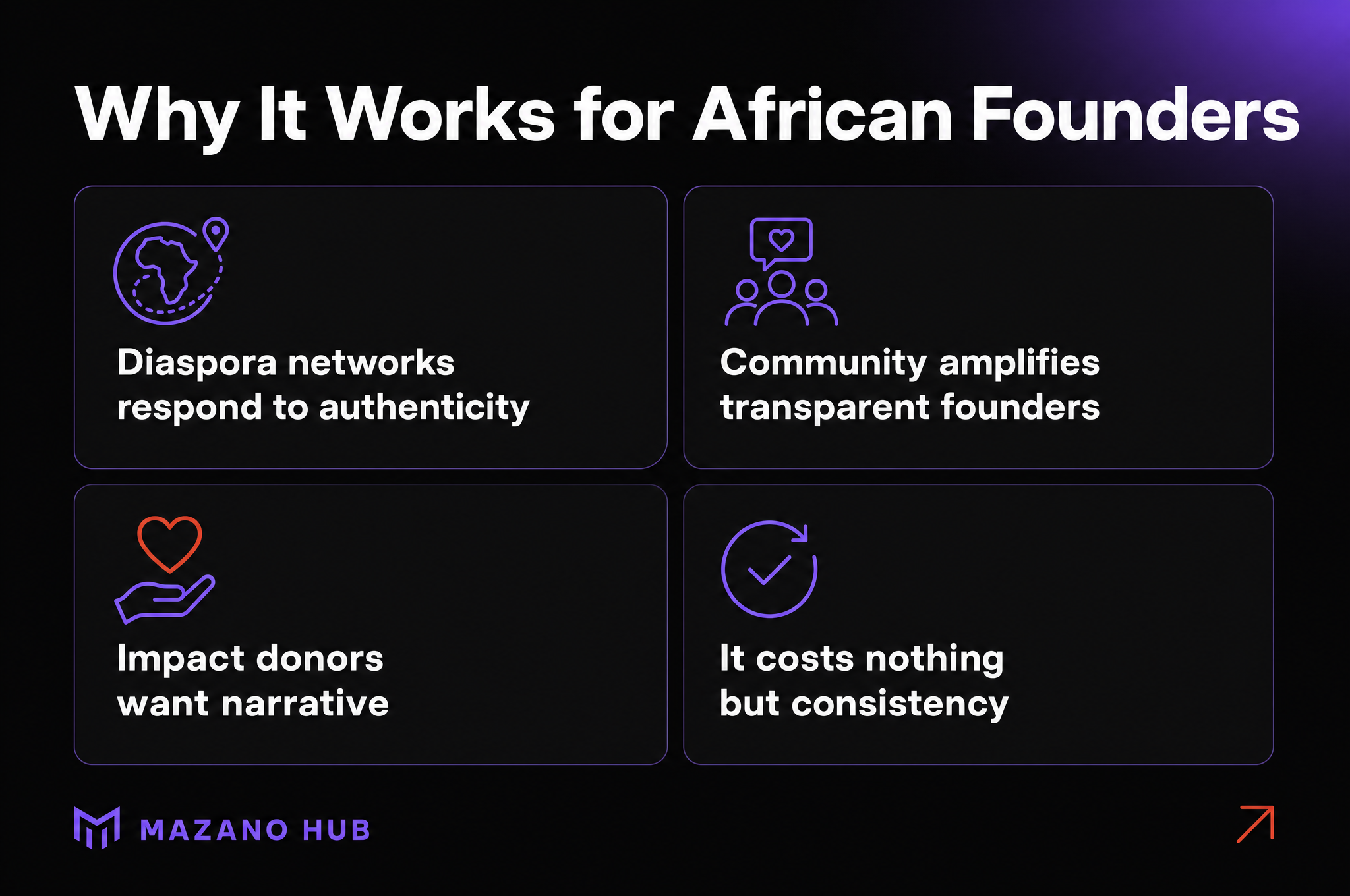
He did not wait until his product was perfect. He did not wait until he had a polished pitch deck. He started sharing the journey, and the journey attracted exactly the people he needed. This is building in public — and it may be the most practical growth strategy available to African founders who are working with limited budgets, tight networks, and big ambitions. 1. What "Building in Public" Actually MeansBuilding in public is the practice of sharing your entrepreneurial journey openly as it happens — not just the highlight reel, but the full story. It means posting about the customer who said no and what you learned. It means sharing your revenue numbers when they are embarrassingly small. It means asking for feedback before your product is finished. It means narrating your decisions as you make them, not just announcing results after the fact. This is not the same as oversharing or performing vulnerability for likes. Building in public is strategic. You are documenting real progress, real thinking, and real lessons — and making them visible to the people who can help you move faster. It is also not just for technology founders or Silicon Valley types. A tailor in Harare who posts the before-and-after of a complicated commission, explains why the fabric choice matters, and asks followers what they would change — that is building in public. A bakery owner who shares her weekly cost breakdown and asks for recipes — that is building in public. A consultant who narrates her thinking process on a client problem, without revealing confidential information — that is building in public. The core principle is this: your journey has value before your product is finished. The process itself — the struggle, the learning, the iteration — is interesting and useful to others. Sharing it turns your network into a resource, and turns strangers into early supporters. 2. Why It Works for African Founders SpecificallyFor African founders — especially those operating in Zimbabwe and across the continent — building in public addresses several structural challenges at once. Diaspora networks respond to authenticity. There are millions of Zimbabweans and Africans living abroad who want to invest, mentor, and partner with founders at home — but they need to trust the person first. A six-month timeline of honest posts builds more trust than a one-time pitch. When a diaspora professional in London or Atlanta has been following your journey for weeks, your funding ask is not a cold request — it is a natural next step. Church and community networks amplify transparent founders. Faith communities, by nature, champion people they know and trust. When a founder is consistently open about their work, their values, and their challenges — in a way that reflects integrity — church networks do what they always do: they spread the word. Your pastor becomes your PR manager. Your cell group becomes your first customer base. Impact donors want narrative, not just numbers. The donors and grant-making organizations that fund African entrepreneurship do not respond primarily to spreadsheets — they respond to stories of resilience, learning, and growth. Building in public gives you a living narrative. When you apply for a grant, you are not writing from scratch — you are synthesizing months of documented work. It costs nothing but consistency. LinkedIn is free. WhatsApp statuses reach your whole network. A weekly post takes 20 minutes to write. For founders operating in constrained financial environments, this is marketing at near-zero cost with compounding returns. 3. The Fear of Transparency — and How to Overcome ItThe resistance to building in public is real. It surfaces in three main forms. Perfectionism: "I will share when it is ready." This is the most common trap. The product is never ready enough, the results are never strong enough, and so the founder stays quiet while potential supporters move on. The fix is to redefine what you are sharing. You are not sharing a finished thing — you are sharing a learning. Those are never imperfect, because the learning is the point. Competitive fear: "If I share my idea, someone will steal it." This fear is almost always overestimated. Ideas are not scarce — execution is. By the time a competitor hears your idea, processes it, decides to pursue it, and figures out the customer, you have three months of head start and real market knowledge. What you gain from sharing — feedback, supporters, early customers — far outweighs the marginal risk of a competitor learning your concept. Cultural norms around failure: In many African communities, admitting struggle is read as weakness. There is a deeply ingrained pattern of presenting success, even when the reality is harder. Building in public asks you to challenge this pattern — not to perform pain, but to normalize the honest difficulty of building something. The founders who do this consistently find that the response is overwhelmingly supportive, not judgmental. People respect the honesty and root for the underdog.
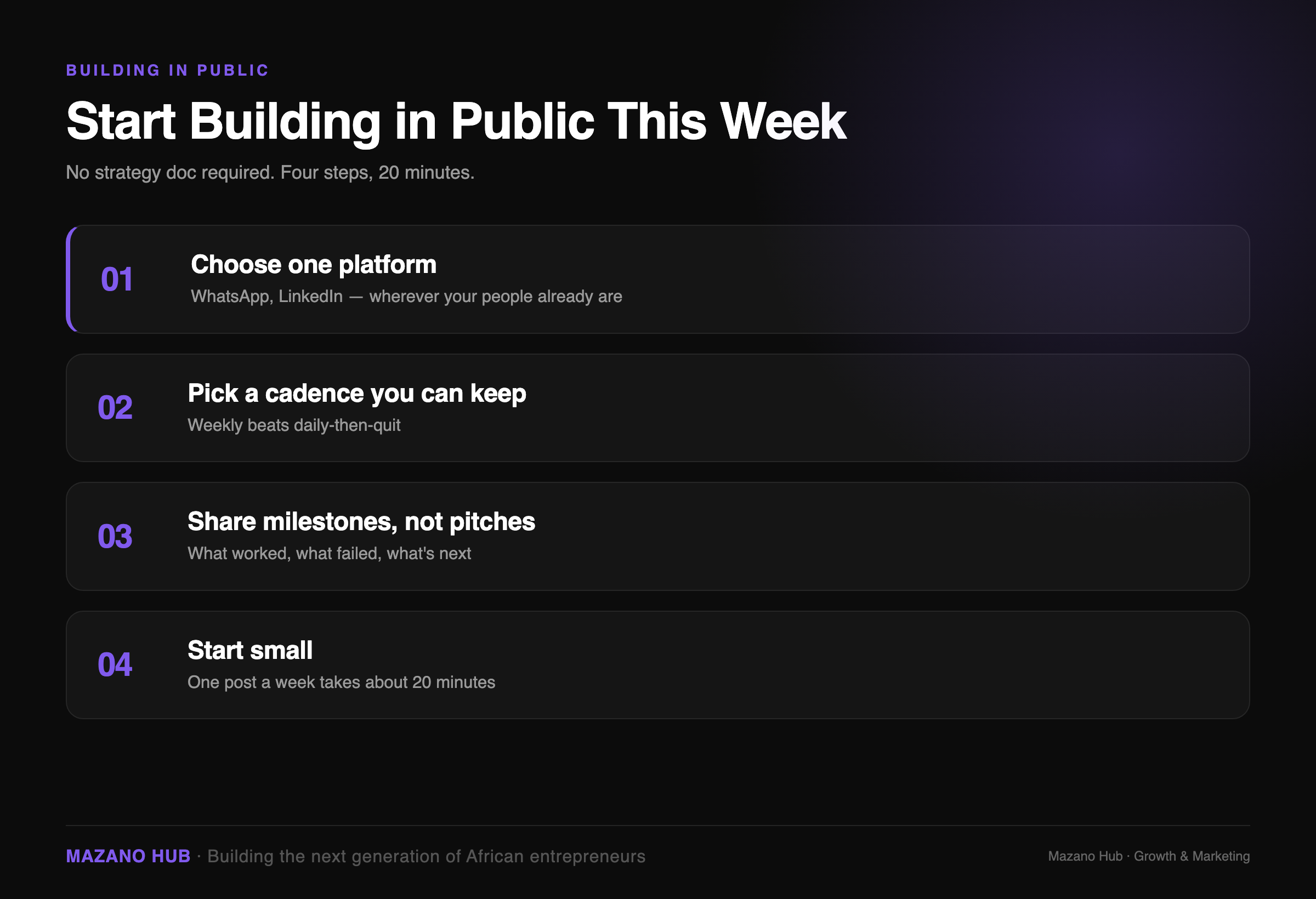
The antidote to all three fears is the same: start small. One post. One platform. One lesson shared per week. You do not have to narrate everything — just enough to demonstrate that you are in the work, learning, and moving. 4. How to Start Building in Public This WeekYou do not need a strategy document or a content calendar. You need four decisions. Choose one platform. LinkedIn is the highest-leverage option for African founders right now — diaspora professionals, impact investors, and media contacts are all active there. If your audience is local, WhatsApp status or a Facebook page will reach them faster. Twitter/X still has traction in tech and startup communities. Pick one and stay consistent there before expanding. Choose a cadence you can keep. Once per week is enough. Monday morning or Friday afternoon — whenever you naturally reflect on the week — is the best time to post. The cadence matters more than the frequency. A post every Friday for six months is worth more than daily posting for two weeks followed by silence. Choose a format that fits your voice. Some founders write short essays. Others share raw numbers. Others post photos with captions. The format is less important than the honesty. Ask yourself: would this post teach someone something real? Would it show where you actually are right now? If yes, it is the right post. Start with a milestone, not a pitch. Your first post should not be "I am launching a business — please support me." It should be "Here is one thing I built, learned, or decided this week." Let the milestone speak. The support follows when people see you are actually in the work.
|
||||
|
Mazano — Faith-Driven Entrepreneurship Incubator
Building Zimbabwe's next generation of founders
You are receiving this because you subscribed to Mazano Hub. |